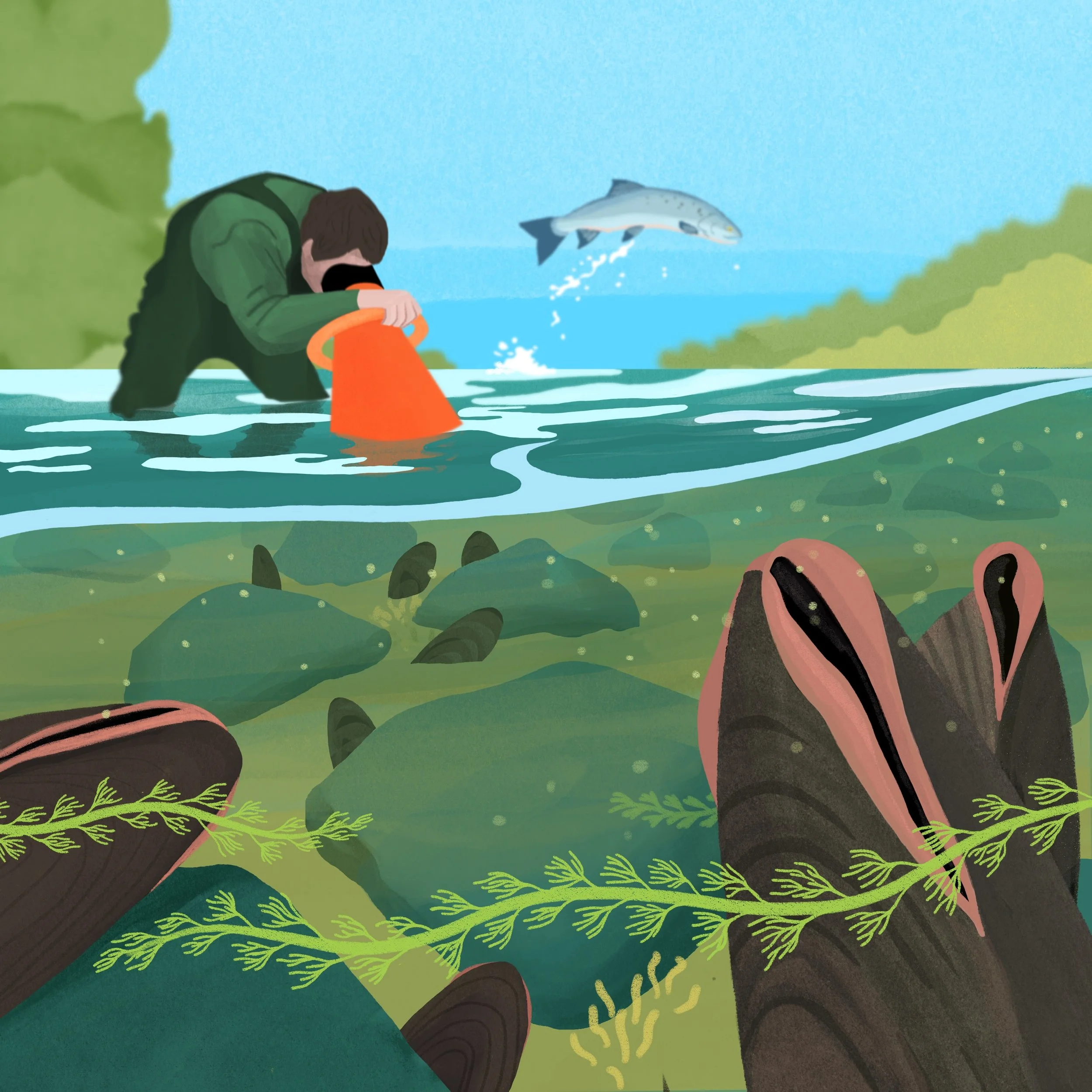
Cover artwork by Ale Silva
On the emerald isle of Ireland, an easily-overlooked creature holds the history of a nation within its shell. From the rise and collapse of heavy industry, to a bloody civil war, the riverbeds of Ireland have been witness — and they tell a story of change and possibility stretching far beyond any human lifetime.
With the help of guest producer Caitlin Kennedy, we're tracing the modern arc of Northern Ireland through the story of the freshwater pearl mussel.
Ongoing support for this podcast comes from listeners just like you. To keep this show going, join our community at patreon.com/futureecologies
Our supporters get access to early episode releases, a community discord server, discounted merch, and exclusive bonus content.
Show Notes and Credits
Produced by Caitlin Kennedy and Mendel Skulski, with help from Fiona Glen
Featuring the voices of Frank Mitchell, Mary Catherine Gallagher, Stiofán Cullen, and Sebastian Graham.
Music by Olly Keen, Thumbug, Martin Austwick, Sorcha Kennedy, plus our theme by Sunfish Moon Light
From Caitlin:
As well as the episode’s incredible contributors, a huge thank you to everyone at the Ballinderry Rivers Trust, especially Mark Horton for introducing me to freshwater pearl mussels in the first place. Thank you to Dr Evelyn Moorkens and Dr Ian Killeen for their tireless work researching this endangered species over the past 30 years: without them, Irish pearl mussels would be in much worse shape. I'm incredibly grateful to Wetland Surveys Ireland, Dennis Funk, Sarah Jones & John D’Arcy for helping bring this project to life and to Carrie, Sorcha & Garfield for lending an ear with wise words of feedback. And finally, thank you Karina for lending me hydrophones and sharing in my sonic enthusiasm and Jessie for endlessly nerding out about mollusks with me - hopefully we'll come back as one in the next life.
See also: Caitlin's article about nacre for Scientific American, and her soundcloud
PS. Please do not go stomping around in sensitive Northern Irish river habitat looking for mussels without a survey license!
This episode includes audio recorded by soundscalpelcom, majorasflask, hampusnoren, jorickhoofd, spookee, klankbeeld, morganveilleux, megashroom, inspectorj, jeffnevington, danlucaz, robinhood76, belanhud, asherkaye2, nox_sound, dibko, volivieri, adviseme333, hollandm, jomungus, qubodup, cabled_mess, mkoenig, department64, democrocernus, wigglesworth, iainmccurdy, accessed through the Freesound Project.
Photos
Citations
Chowdhury, M., Marjomäki, T., & Taskinen, J. (2021) Effect of glochidia infection on growth of fish: Freshwater pearl mussel Margaritifera margaritifera and brown trout Salmo trutta. Hydrobiologia, 842, 175–185.
Clarke, S. (2023) Rethinking River Restoration: a challenge for freshwater ecology. Freshwater Biological Association
Filipsson, K., Petersson, T., Höjesjö, J., Piccolo, J., et al (2018). Heavy loads of parasitic freshwater pearl mussel (Margaritifera margaritifera L.) larvae impair foraging, activity and dominance performance in juvenile brown trout (Salmo trutta L.). Ecology of Freshwater Fish. 27. 70-77. 10.1111/eff.12324.
Flanagan, E. (2017) Mapping the mills of Northern Ireland. BBC News NI
Geist, J., Moorkens, E., Killeen, I., & Kuehn, R. (2025). Genetic diversity and differentiation of Irish Freshwater Pearl Mussels (Margaritifera margaritifera): Identification of conservation units and recommendations for the management of wild and hatchery populations. Aquatic Conservation Marine and Freshwater Ecosystems 35(7)
Harrison, S., Cowhig, K., & Sullivan, T. (2024) Still waters and deep: Habitat characteristics, density and distribution of a lake-dwelling population of the freshwater pearl mussel Margaritifera margaritifera. Global Ecology and Conservation (54), e03130
Heritage Fund (2012) Boost for conservation of Ireland’s oldest species of mussel
Horton, M., Bell, D., Keys, A. & Mitchell, F. (2018) Freshwater pearl mussel survey of Northern Ireland 2017. Report prepared by Ballinderry Rivers Trust for the Northern Ireland Environment Agency. Northern Ireland Environment Agency Research and Development Series No. XX/XX.
Ireland's Great Hunger Museum (2019) Learn About the Great Hunger. Quinnipiac University
Irish River Project (2021) Irish Pearl Mussel Project: List of CatchmentsLucey, J. (2005). The Irish pearl: A cultural, social and economic history. Wordwell Books.
Kakisawa, H., & Sumitomo, T. (2011). The toughening mechanism of nacre and structural materials inspired by nacre. Science and Technology of Advanced Materials, 12(6).
Moorkens, E.A. (1999) Conservation Management of the Freshwater Pearl Mussel Margaritifera margaritifera. Part 1: Biology of the species and its present situation in Ireland. Irish Wildlife Manuals, No. 8.
National Museums Northern Ireland (2018) Margaritifera margaritifera – freshwater pearl mussel. Northern Ireland Priority Species
Nordsieck, R. (2025) The River Pearl Mussel. The Living World of Molluscs
O'Brien, S. (2020) From the times of dinosaurs - Irish farmers fight to protect pearl mussels. IrishCentral
Pekkarinen, M., & Valovirta, I. (1996). Anatomy of the glochidia of the freshwater pearl mussel, Margaritifera margaritifera (L.). Archiv für Hydrobiologie, 137(3), 411–423.
Skinner, A., Young, M., & Hastie, L. (2003). Ecology of the Freshwater Pearl Mussel. Conserving Natura 2000 Rivers Ecology Series No. 2 English Nature, Peterborough.
Stelzer, S., Worf, D., Flödl, P., Sindelar, C., Höfler, S., Hauer, C. (2023) Nature-based solutions in freshwater pearl mussel rivers – A novel approach for self-dynamic desanding developed in a physical model test. Limnologica (98), 126032
Verma, A., Rahman, A., Hussain, S., & Singh, N. (2025). Freshwater Mussels as Multifaceted Ecosystem Engineers: Insights into Their Ecological Importance, Bioindication, and Economic Contributions. Water. 17. 1629. 10.3390/w17111629.
Vikhrev, I., Makhrov, A., Artamonova, V., et al. (2019) Fish hosts, glochidia features and life cycle of the endemic freshwater pearl mussel Margaritifera dahurica from the Amur Basin. Sci Rep 9, 8300 (2019).
Wegst, U., & Ashby, M. (2004). The mechanical efficiency of natural materials. Philosophical Magazine, 84(21), 2167–2186.
Wetland Surveys (2023) The Pearl Mussel Project
Wisniewski, J., Bockrath, K., Wares, J., Fritts, A., & Hill, M. (2013). The Mussel–Fish Relationship: A Potential New Twist in North America? Transactions of the American Fisheries Society, 142(3), 642–648.
You can subscribe to and download Future Ecologies wherever you find podcasts - please share, rate, and review us. We’re also on Facebook, Instagram, Twitter, and iNaturalist.
If you like what we do, and you want to help keep it ad-free, please consider supporting us on Patreon. Pay-what-you-can (as little as $1/month) to get access to bonus monthly mini-episodes, stickers, patches, a community Discord chat server, and more.
Future Ecologies is recorded and produced on the unceded, shared, and asserted territories of the WSÁNEĆ, Penelakut, Hwlitsum, and Lelum Sar Augh Ta Naogh, and other Hul'qumi'num speaking peoples, otherwise known as Galiano Island, British columbia, as well as the unceded, shared, and asserted territories of the Musqueam (xwməθkwəy̓əm) Squamish (Skwxwú7mesh), and Tsleil-Waututh (Səl̓ílwətaʔ/Selilwitulh) Nations - otherwise known as Vancouver, British Columbia.
Transcription
Introduction Voiceover 00:01
You are listening to Season Six of Future Ecologies.
Mendel Skulski 00:09
Welcome back. Today we're wrapping up our sixth season with a very special episode. With the help of guest producer Caitlin Kennedy, we're taking you to the Emerald Isle of Ireland, and meeting an easily overlooked creature that holds the history of a nation within its shell. From the rise and collapse of heavy industry to a bloody civil war, the riverbeds of Ireland have been witness, and they tell a story of change and possibility stretching far beyond any human lifetime. From Future Ecologies, this is Mussel Memory.
Introduction Voiceover 00:56
Broadcasting from the unceded, shared and asserted territories of the Musqueam, Squamish, and Tsleil-Waututh, this is Future Ecologies – exploring the shape of our world through ecology, design, and sound.
Frank Mitchell 01:42
So these are all the things you need whenever you have a team going out with you, and one of the most important things is your life jacket. Let's go on an adventure.
Caitlin Kennedy 01:58
Who lives in a river? Do you know? I certainly didn't. I've explored the coastline, looking for starfish and crabs in rock pools, but I'd never really perused a riverbed. That's all about to change.
Frank Mitchell 02:14
Just watch your step. You wouldn't drop into a hole or something.
Caitlin Kennedy 02:23
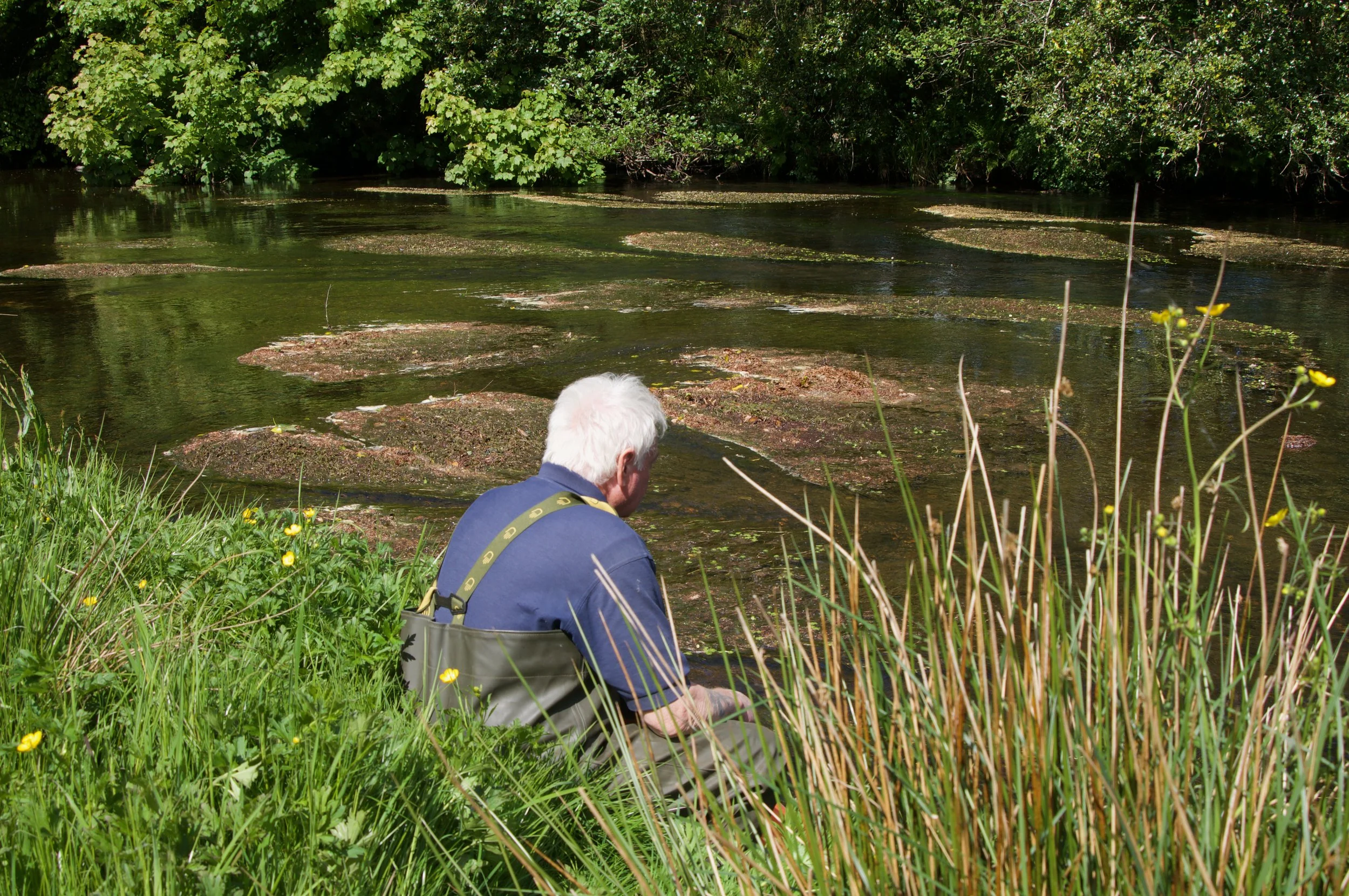
We're in the Ireland of legend, green mossy boulders tumbling down into a fast flowing river full of tentacle-like ranunculus, which provides endless hiding places for aquatic species. My guide, Frank Mitchell, and I are wearing our life jackets, yes, but also waders up to our chests. As we pick our way down the banks, I imagine diving down and swimming amongst the very creatures we're looking for.
Frank Mitchell 03:01
If you come up here here, and it's not easy for you to see them, and they're all in there. And if you come on over here.
Caitlin Kennedy 03:11
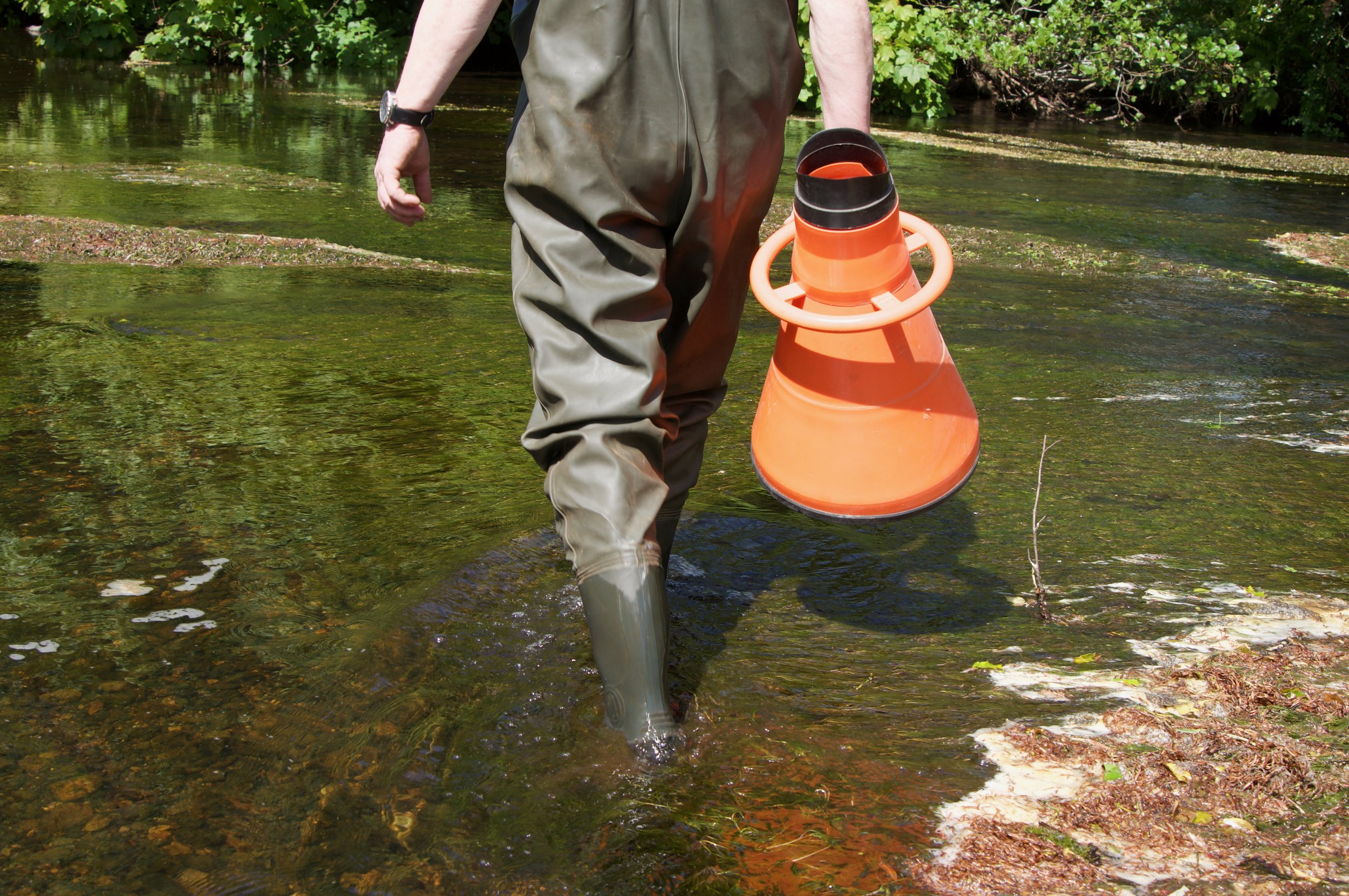
Frank passes me the bathyscope, a traffic cone-shaped instrument with a perspex pane for peering down to the riverbed. When my eyes adjust to the shadow cutting through the surface of the water, there they are — freshwater pearl mussels!
Caitlin Kennedy 03:29
Wow! There's loads of them!
Frank Mitchell 03:31
See them in there?
Caitlin Kennedy 03:33
Oh yeah!
Frank Mitchell 03:34
You see them underneath the bark of the tree?
Caitlin Kennedy 03:36
Until recently, I had been oblivious to the existence of any river mussels, but in 2021 I came to the Ballinderry River, which wends its way through the rolling hills of County Tyrone in Northern Ireland. I discovered a species whose existence was so very different to my human life, I became a little obsessed. Their lives are fascinating, a paradox of stillness and flux. But more than anything, I wanted to understand why they're struggling to survive in the rocky streams of Ireland. Frank's life, like those of the creatures he cares for, is deeply entwined with the Ballinderry River. Here he is responsible for the longest running freshwater pearl mussel breeding program in the world.
Frank Mitchell 04:23
And I've been here now for the last 30 years.
Caitlin Kennedy 04:34
Frank spent his youth fishing the Ballinderry's dappled banks and building weirs out of sticks near its source.
Frank Mitchell 04:41
I was born and raised on the Ballinderry River.
Caitlin Kennedy 04:44
But he never imagined he'd now be working to save another creature that calls the river home, or that it would be the longest-lived creature anywhere in the UK and Ireland. In the time it's taken Frank's hair to turn white, the oldest mussels in his care have grown from less than a millimeter to the length of his hand, and they'll continue growing for some time yet.
Frank Mitchell 05:06
And I never realized that I would be actually working on such an interesting and important project with the freshwater pearl mussels.
Caitlin Kennedy 05:16
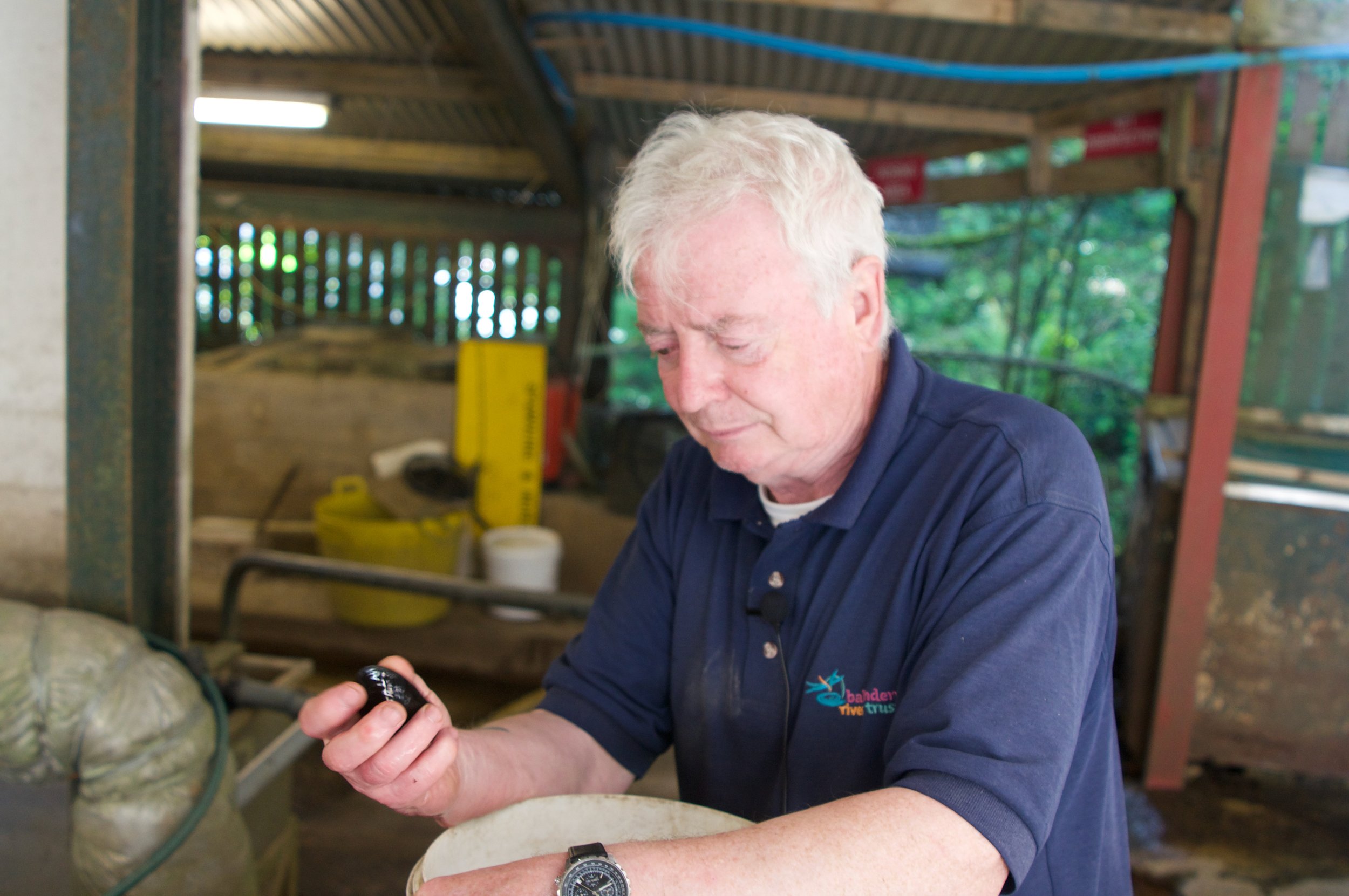
Every day for the past three decades, Frank has arrived at work in his overall and wellies, and traversed a bridge over the river. When he opens the door to an abandoned-looking building, he sees the familiar rows of long white ceramic tanks that form a series of water channels through which the Ballinderry River is diverted.
Frank Mitchell 05:38
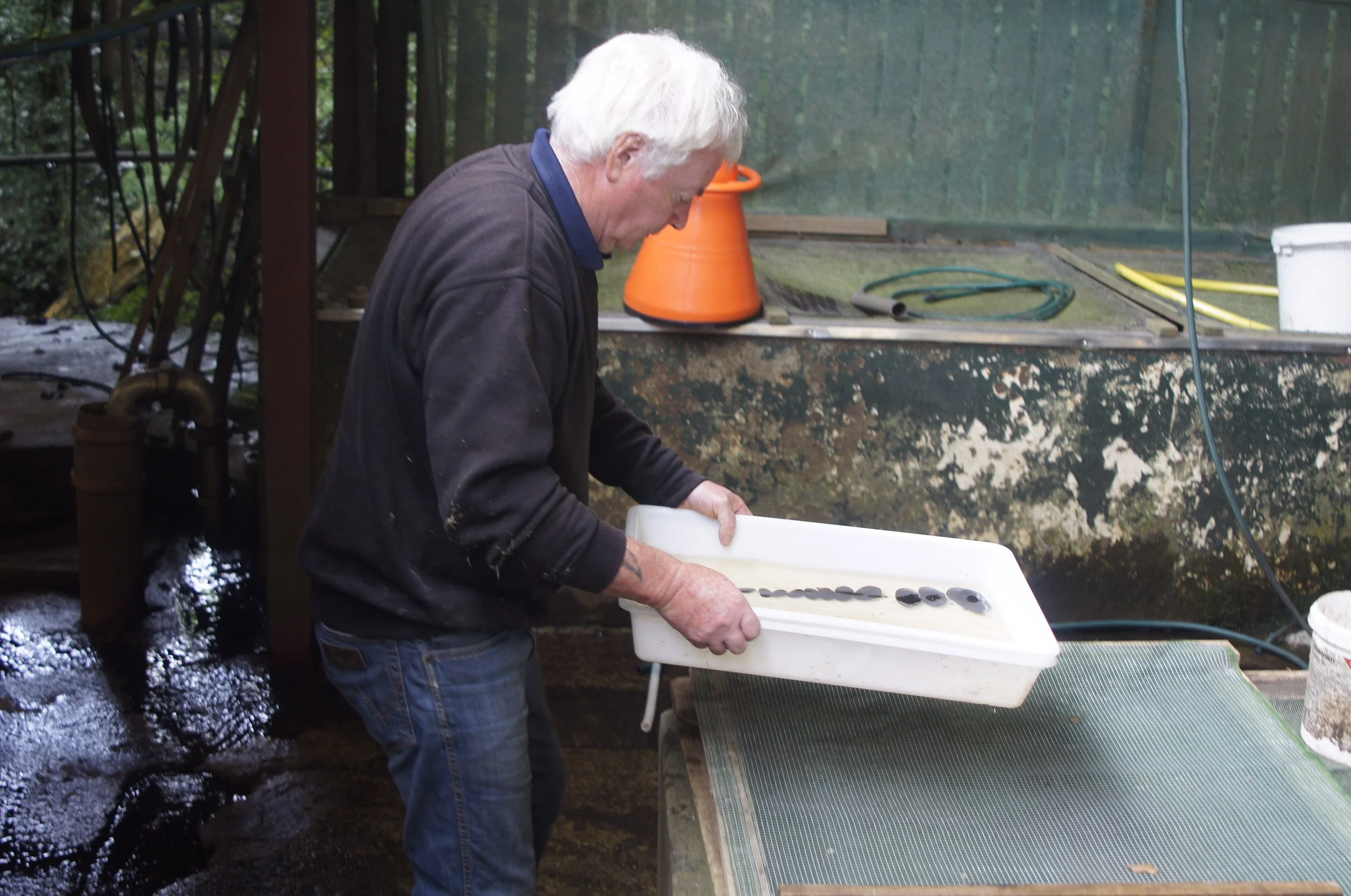
We're walking in our breeding center where the river's coming through naturally. So, we have to keep this clean, so that the mussels that are dropping off here get every good chance of surviving in the gravel.
Caitlin Kennedy 05:53
Frank reaches down into one of the makeshift riverbeds and stirs some recently settled sediment back into the flow of the river.
Frank Mitchell 06:01
And all I'm doing here is just moving the silt off the gravel, trying to keep it clean. So, if you get a look in here, you see all those mussels there.
Caitlin Kennedy 06:15
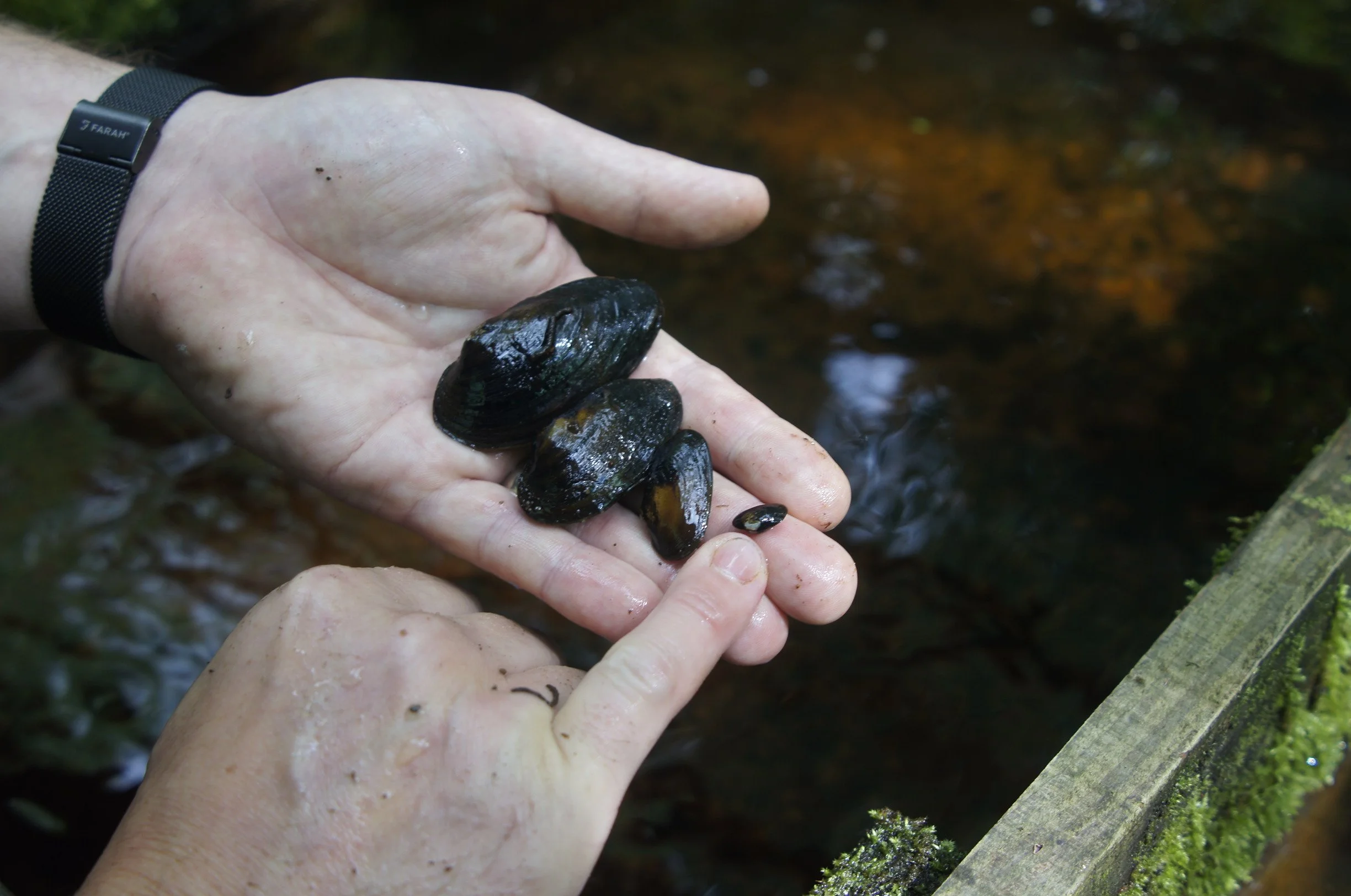
To my untrained eye, what Frank has pulled out of the water looks like a pebble. In their native habitat of rocky streams, it can be hard to discern them, but these are freshwater pearl mussels. When I say mussel, you might be imagining a small blue-black sea mussel, but these mussel shells are rounder and a matte dark brown color. They're much bigger than sea mussels, and don't latch onto any rocks, just lie burrowed in the riverbed, making them pretty hard to spot. You might see these frilly, pale fronds poking out of the shells when they're feeding. These are the mussel siphons, sort of an in tube and an out tube. One siphon inhales the water from which they'll extract the food they need, and the other releases water and any waste. At that level, not so different from us... except that in a mussel, they both emerge in the same place. And the same pipes that are used for eating are also used for breathing... and getting rid of waste... and reproducing.
Caitlin Kennedy 07:23
Oh, and did I mention that freshwater pearl mussels live for 150 years? Some of the oldest animals on the planet are in fact mollusks, like the record-breaking black Quahog clam, who live for up to 500 years. Our Irish pearl mussels might not hold the title, but they're still seriously long-lived, especially for their size. It's mind-blowing to think that there are mussels alive today who were born before the Titanic set sail.
Frank Mitchell 07:53
I remember seeing me first mussels when I was a young cub fishing along the river. I didn't know an awful lot about them. It's no real big deal to me, but when you start to work with them, and you start to learn about them, and how important they are, and then you go to a mussel site. The first muscle site I went to, a real good one, was away down in Donegal and Galway. And when I come across these big mussel sites, it's mind blowing.
Caitlin Kennedy 08:21
This dense population of mussels in a bend of the river might be a rarity now, but it would have been a commonplace sight to Frank's grandfather. By the 2010s, the mussel population in the Ballindery had crashed by 90% in little more than a human generation.
Mary Catherine Gallagher 08:40
I think you would find some freshwater pearl mussels in most rivers in Ireland, at one point.
Caitlin Kennedy 08:46
I drove the length of Ireland to meet Dr. Mary Catherine Gallagher, an aquatic ecologist who worked on a freshwater pearl mussel restoration project in County Kerry. It's a rugged coastal region carved up by Atlantic sea lochs in the southwest corner of the island.
Mary Catherine Gallagher 09:04
They're present in Europe and also globally. So, they're a worldwide species. On a global level, they're classified as being endangered, but then on an Irish and European level, they're critically endangered.
Caitlin Kennedy 09:16
In Ireland, populations are clinging on down the west coast, particularly those rocky, hilly places that are harder to farm intensively or build houses on —
Mary Catherine Gallagher 09:26
from Donegal all the way down to Cork,
Caitlin Kennedy 09:30
but the reason scientists like Mary Catherine have been working with freshwater pearl mussels isn't just because they're endangered. Freshwater pearl mussels are sometimes referred to as an umbrella species. If you make conditions right for them, everyone else in their vicinity benefits, including humans.
Mary Catherine Gallagher 09:48
They will filter about 50 liters of water a day, that's what an adult mussel can do. So, I've seen it written, like, you know, the amount of water for a bath, which is an awful lot. And they're filtering it, and obviously they're doing that, so they can get food, but that action also has a cleaning effect on the water. They also can remove pathogens that are harmful to human health as well.
Caitlin Kennedy 10:14
And as they filter all matter flowing through the river, sometimes it can give rise to the very thing that gives these mussels their name.
Mary Catherine Gallagher 10:23
Some mussels can contain a pearl.
Caitlin Kennedy 10:27
Some, but not many. Pearls aren't a standard part of the mussel's biology, they're an accidental defense mechanism. So, despite their name, you're actually only likely to find a pearl inside one in 7000 mussels. Filter feeding mollusks have evolved to prevent large debris from getting trapped inside their shell and irritating the outer layers of their bodies. If something does get trapped, the mussel has an ingenious strategy. It secretes the same substance which lines their shell gradually coating the object until smooth and rounded.
Mary Catherine Gallagher 11:05
It's usually some sort of like a bit of sand or some sort of fragment that's like foreign to the mussel, but it's actually almost like an immunological response.
Caitlin Kennedy 11:14
Almost like us producing eye goo.
Mary Catherine Gallagher 11:16
Yes, exactly, but a lot more beautiful.
Caitlin Kennedy 11:19
This substance is called nacre, or more commonly mother of pearl, and it catches light with a kind of muted glow of colors. At the microscopic level, highly ordered hexagonal bricks of calcium carbonate tessellate and form layers. When visible light enters, some wavelengths are trapped, whilst others scatter, creating a pearlescent effect. Unfortunately, this has brought the mussels a lot of unwanted attention. Throughout recorded history, pearl fishers have scooped these vulnerable mollusks out of river beds, opening them up in search of treasure.
Mary Catherine Gallagher 12:02
And because not every mussel contains a pearl, that could mean hundreds of mussels being taken out of the river, opened up, and if they didn't have a pearl, just being like discarded on the river bank. That's obviously an illegal practice in Ireland now as well.
Caitlin Kennedy 12:17
Even when a mussel lacks its eponymous pearl, the inside of its shell is entrancing to look at. Some shell interiors have gold streaks from iron-rich waters, some are more pink or blue, depending on the metals nearby. Nacre is a bit of a super substance, being stronger than steel and less brittle than the limestone from which it's made. Material scientists have long tried to replicate nacre's impressive ability to stop cracks from forming in their tracks, a feat achieved by the perfect alchemy of hard calcium carbonate bricks and soft silk like proteins, which hold the layers together. Mussels can even use nacre to glue themselves back together again. If their shells get a little worn, they will simply lay down more layers of nacre, gradually repairing the damage from the inside out. And yet, living muscles never intentionally display this mystical-looking substance to the outside world. What Mary Catherine sees when conducting surveys is two matte black shells kept almost completely shut, but as an ecologist, she's come to appreciate them for far more than their shiny nacre.
Mary Catherine Gallagher 13:31
You'll see the shells, and then you'll see the openings for the siphons, but they're really beautiful, like especially the inhaling siphon. It has these like frilly edges, I think it depends on the situation, or on the lighting, maybe, but sometimes it's kind of a grayish color, sometimes it's more of like maybe a light pinky kind of color, and that's all you'll see usually, and then inside it's just like, yeah, as like a soft-bodied gloopy organism.
Caitlin Kennedy 13:59
And what does a gloopy organism encased in a shell need to live its best life?
Mary Catherine Gallagher 14:04
They like really clean water. They like high oxygen levels. They like what's called this Goldilocks flow, so it's kind of like not too fast, not too slow, a very in the middle kind of flow rate in the river. In terms of the substrate, or like the river bottom, they like a kind of a diversity, really. They like some kind of bigger rocks and boulders, and then some smaller sediments as well. It's nice if the river has little riffles in it, so areas that are really nice and well oxygenated. It can be nice if the catchment has, like, a lake higher up, so that can kind of help to stabilize the flow of water. Low levels of nutrients, they don't like, you know, eutrophic waters. Basically clean, medium level of flow, nice diversity in the riverbed, good levels of oxygen.
Caitlin Kennedy 14:52
...and fish?
Mary Catherine Gallagher 14:53
And fish! Of course! The fish are really important. I always forget about the fish, I'm so focused on the mussels. But obviously you have no mussels without fish.
Caitlin Kennedy 15:02
This is the bit about freshwater pearl mussels that completely captivated me when I first learned about them, because the beginning of their life is just so wildly different to the rest of their very long, very sedentary years. See, a freshwater pearl mussel larva cannot survive without latching on to the gills of a fish.
Frank Mitchell 15:23
Just checking on me fish to see how they're doing. They're doing okay. I'm just going to lift out a fish here, and I'm just going to take a look at the gills of the fish, just to see if there's any mussels on them, or they're starting to drop off. This, by the way, doesn't do the fish any harm, okay. You're not going to see much. It's very hard to see them, but there's a few wee white specks there.
Caitlin Kennedy 15:50
As Frank gently pulls back the little trout's gill cover, I get a glimpse of the white spots he's describing. Really, it just looks like the fish has some goo stuck on its gills, but each globule contains 1000s of larvae, and under a microscope each one looks like
Mary Catherine Gallagher 16:08
Like a miniature mussel, like a teeny tiny mussel.
Caitlin Kennedy 16:10
These are the lucky few, the ones who beat the clock, because baby mussels, or glochidia, to use their scientific name, have just 24 hours to latch onto the gills of a salmon or trout. After that, they perish. At this stage, they're extremely small, about a third of the size of a grain of sand.
Speaker 1 16:33
And they're tiny, but they are able to sense when a fish is nearby. So, a salmon or a trout in Ireland are the two species that they like to attach onto. They're basically kind of like floating around in the water. When they sense that a salmon or trout is nearby, they actually start opening and closing their shells, so it's called snapping. And if they are lucky enough to be inhaled by the fish and then pass over the gills, and if they happen to snap at the right moment and grab onto the gills, they can stay there for nine months, and they go everywhere the fish goes.
Caitlin Kennedy 17:09
For quite a long time, I couldn't understand why evolution had resulted in such a perilous obstacle course for the baby mussels, but the more I spoke to Frank and Mary Katherine, the more it made sense. Newly hatched microscopic mussels are at huge risk of predation, so their fish host becomes their mobile shelter. But more crucially, if freshwater pearl mussels dispersed their young just through the water, each population would be washed further and further downstream and quickly into the sort of slow sediment-laden water, they can't tolerate. When they drop off the gills after nine months, the chances are they'll be roughly in the same place they started, or even a bit further upstream.
Caitlin Kennedy 17:54
This is actually quite a common reproduction strategy in river mussels, and some are much more aggressive about it. In the US, pocketbook mussels have evolved a natural lure that looks just like a tiny fish. An adult pocketbook will bait an unsuspecting predator near its open shell and then clamp shut, trapping the fish for up to an hour, whilst it blasts the gills with larvae. Our Irish pearl mussels are tame in comparison, Ecologists have battled whether to call this relationship parasitic or symbiotic. It is clear that having mussel larvae attached to your gills does give you a bit of a disadvantage, so infected fish end up smaller than uninfected fish, but in cleaning the river, it's also likely that the mussels create an ideal habitat for fish spawning.
Caitlin Kennedy 18:44
Newly educated, I reckoned it was time to try and find some mussels by myself.
Caitlin Kennedy 18:54
I'm looking for pearl mussels in this river in Kerry...
Caitlin Kennedy 19:01
A word on looking for mussels, you actually have to have a license from the National Parks and Wildlife Service to do what I'm doing, because of how endangered these mollusks are. Swimming or fishing, fine-ish — there are some pretty mad laws here about riverbed ownership. But these mussels' habitats are super fragile right now, so please don't go grabbing your nearest bathyscope without a licensed professional.
Caitlin Kennedy 19:28
Oh! Hello, Blackbird. ...But it's quite tricky here because the rocks are very dark, so they hide the muscles very well, so I'm just looking for signs of them, like a siphon. Definitely no mussels there. Oh, there's some very rapidly moving trout. God, they've got places to go. From what Mary Catherine and Frank said, they like a kind of dappled space, so I'm looking under trees, and it's tricky, because whilst I want to get close, I don't want to drop my audio recorder in. There's definitely a lot of trout and waterboatmen, but not a lot of mussels.
Mary Catherine Gallagher 20:28
Yeah, they were at one point really widespread and really numerous. Their range in general over the past few reporting cycles isn't really contracting much, so they can still be quite widespread, but it's the numbers in the populations that are really declining. So we have a lot of kind of like little remnant populations or populations that are sort of functionally extinct, so there's adults there but they're not managing to reproduce successfully, and there's no juvenile recruitment.
Caitlin Kennedy 20:55
To make sense of this drastic decline, we need to emerge from the surface of the stream and look around at the Ireland visible before us. From this vantage point, we see that the bank has been completely cleared on one side, giving an open view of a field of cows, some ambling down the bank to drink directly from the river. Beyond the field are the Laggan hills, almost entirely bare, except for three perfect rectangles of monoculture pine plantation. The river, too, has artificially straight lines where it's been channeled. On the other bank, through the boughs of a few small trees, a tractor spreads herbicide on the marshy land, getting rid of the rushes for a field of grazing sheep. My dad grew up in Ireland, so we visited every year. He and I both agreed this view is far from unusual, and it's not just visually a tidied landscape. London's Natural History Museum created a biodiversity intactness index to measure ecosystem health. The index has since been adopted by the United Nations to tell which countries are most nature depleted. Out of 240 countries on the index, Northern Ireland ranks 13th... from the bottom. The Republic of Ireland ranks only one place above. How did this happen? How did this island come to be so desperately nature depleted? When Frank was growing up in the 1950s, things actually looked pretty different
Frank Mitchell 22:46
To me, those were good days, and the river always seemed healthy and doing well. Spent a lot of me time playing, fishing. Those days you didn't have money to buy a fishing rod or nothing.
Caitlin Kennedy 22:59
So older fishermen would give young Frank some bait to tie to his hazel stick, and that kept him happy. Although other forms of life, like mussels, were of little consequence to him.
Frank Mitchell 23:10
I remember seeing mussels when I was a cub out fishing, but I never really paid much attention to it. To me, it was just a shell.
Caitlin Kennedy 23:19
There are few habitat records from the 50s, but mussels were undoubtedly more numerous than they are now.
Frank Mitchell 23:26
In my time, when I'm working with 'em, and I've been working with 'em around 30 years, their profile has lifted well up from the 50s and 60s, where they really weren't protected. Like, I mean, they still had men coming out, poaching, looking for these pearls.
Caitlin Kennedy 23:43
Those men would sit in glass-bottomed boats to search the riverbed for telltale frilly siphons. From there, they could easily reach in and scoop the large shells out, crack them open, and hope for a pearl. And for every pearl they'd find, at least 5000 mussels would pay with their lives. But despite Frank's early love of the outdoors, he couldn't have imagined working in nature protection. It just wasn't a job in those days. People in the 50s and 60s still thought of nature as a bottomless resource. Besides, Frank had a humble start in life.
Frank Mitchell 24:22
I never had any real big desire to be anything special, you know. My role in life was, because I had no qualification, was to just get a job, keep out of trouble, keep busy.
Caitlin Kennedy 24:36
At age 15, Frank got a job in the local textiles factory, an incredibly common trajectory for young boys and girls of that era. Everyone in Northern Ireland knows someone who worked in textiles.
Frank Mitchell 24:49
I mean, I remember making lovely fancy silk shirts, silk clothes. Bell bottoms was a big thing in my time here. You'd have loved it!
Caitlin Kennedy 24:57
It's true. Frank and I both have a passion for flashy shirt and snazzy trousers. But the era of opportunity couldn't last forever, and though Frank tried to avoid it, trouble was on the horizon for people and mussels.
Mendel Skulski 25:15
We'll pick up this thread when we come back — after the break.
Mendel Skulski 25:24
And we're back. I'm Mendel. This is Future Ecologies. And on today's show, producer Caitlin Kennedy is tracing the modern arc of Northern Ireland through the story of the freshwater pearl mussel.
Caitlin Kennedy 25:38
It's the 70s. Frank is living out his snappily dressed youth in the textile factory, having put aside his love for the river for now. But as we're about to discover, its health will become central to his story and that of Ireland's freshwater pearl mussels.
Caitlin Kennedy 25:56
Textiles, rivers, and the people that work the land are so inextricably linked on the island of Ireland, that the Dublin Customs House building, built in the 1780s, features a weathered figure crowned by pearls and wearing a turban of flax plant. This statue is the spirit of the Bann River, and it shows two core tenets of the Irish economy at the time — flax and pearls. This makes sense, because in the 18th and 19th century, freshwater pearl mussels were prevalent. They would have been in most Irish rivers and streams in the rocky, fast-flowing upper sections. As evidence, we can find their namesake pearls in folk stories and mythology from across the island. To understand Ireland's past, especially its historic relationship with land and water, I needed to venture back to when storytelling reigned supreme. So I drove to Átha Í, near Dublin, on the east of the island to meet a folklorist by the name of Stiofán Cullen.
Stiofán Cullen 26:58
My name is Stiofán. I am primarily a storyteller, also a folklorist.
Caitlin Kennedy 27:05
Had they been born pre 500 BC, Stiofán would definitely have held the revered position of celebrated bard. They're a performer through and through. They're also a firm believer that the stories told then shouldn't be sugar-coated to retain relevance in today's world.
Stiofán Cullen 27:23
There's a few different aspects to the pearl. Water in general, rivers, lakes, the sea, wells, they all have strong association with all aspects of folklore, because they're a food source, first of all, and they're also dangerous. You shouldn't go out to the water on certain days or go near the water on certain days, because the dead will emerge and drag you down, or the fairies will emerge and drag you down, because of how common it was for people to drown.
Stiofán Cullen 27:59
There's a few stories where children have gone out gathering pearls, and then later will commit some kind of transgression, and when they speak, they're not able to form words, all that comes out of their mouth is more pearls.
Stiofán Cullen 28:26
The oldest legal system in Europe, composed by the native Irish people. There are laws in there on what we would call today natural conservation. There are laws on when you can fell certain trees, how many of each kind of tree you can fell at a time, and what the penalties for felling them in the wrong season or at the wrong age would be. There's also similar laws on overfishing, what you take from the water, what you take from rivers and the sea. We've had all of this very extractive agricultural process kind of imposed on us that we now see as the norm, and an important aspect of indigeneity is connection to the land and having a kind of reciprocal relationship with the land.
Caitlin Kennedy 29:16
I found it hard to pinpoint when habitat destruction really started in Ireland. After all, the ancient Picts, Britons, and Gaels, they were already clearing forests and draining wetlands well before the Anglo-Saxons arrived. But the pressure on rivers definitely did ramp up with the arrival of the English in the 1600s and it accelerated with an industrial land use that came to be at the core of Northern Irish identity — linen textile mills. If you read about Ireland before the republic gained independence, two things leap out from the annals of history — linen and the famine. Despite England's pivotal role in both, I was actually never taught about either at school. In the 1860s, Ireland was hit by a potato blight that destroyed the staple food of its agricultural workers, killing more than a million people in one of the worst famines ever seen in Europe. Many, many more were forced to emigrate. The British still controlled Ireland in its entirety, and their brutal policies of denying aid and forcing export of everything else the country grew really did increase the death toll. So, the only thing people had to sell was their land.
Sebastian Graham 30:33
A lot of the changes to society happened after the famine.
Caitlin Kennedy 30:37
This is Sebastian Graham, a historian with Ireland Heritage.
Sebastian Graham 30:41
We weren't too badly off up here in Ulster with the famine, but in other areas those rural areas really suffered, and that's why these mills are so important for the rural areas that they kept people from going off to emigrate. They developed their own community around the place, and after the famine, you had the rapid industrialisation, investing in machinery, plenty of workforce, wages were low, and they could export quite a lot of their produce.
Caitlin Kennedy 31:08
Sebastian and I meet at one of the last mills in Northern Ireland to cease production, closing down in just 2015. Approaching through the woodland that has quickly encircled the red brick buildings, you can hardly tell this was a hive of industry, but Sebastian tells me that 180 years ago this mill would have been as loud and bustling as the cities it provided for.
Sebastian Graham 31:32
So we're in Upperlands, which is a historic mill village just outside Maghera, in County Londonderry. It was one of these mill villages that sprung up in the 1700s where you could have a job and a mill, you'd have your terrace house, you would have your school, you'd have everything real close to you.
Caitlin Kennedy 31:53
In a feat of cartography not seen since sea monsters inhabited the earth, Sebastian has mapped all four and a half thousand mills across Northern Ireland.
Sebastian Graham 32:03
Bloody mills everywhere.
Caitlin Kennedy 32:05
As we walk towards the old abandoned mill, we're surrounded on all sides by woodland that has sprung up in the past 10 years as nature reclaims the site, populated by swallows, swifts, and small mammals who've made their homes in the remnants of the mill.
Sebastian Graham 32:22
Isn't that amazing
Caitlin Kennedy 32:23
Big old lake!
Sebastian Graham 32:23
Big big lake. So, again, like this landscape looks natural, but it's completely man-made. There were no lakes here at all, and it was just essentially created to power the mills.
Caitlin Kennedy 32:36
We pause an art deco facade, which must have been an entrance to the new mill. It's a picture of faded grandeur with 1929 emblazoned into the masonry. Sebastian told me that the 1920s marked the peak of linens' desirability, especially for England's upper class. Think crisp white linen suits and tennis attire worn on holiday in the French Riviera. This building would probably have heralded a glamorous age of mechanized progress, as the mill clothed London's elite. I follow his gaze to the side of the clock, and spot two flared sheaths of linen textile, like the tassels on fancy curtains.
Sebastian Graham 33:19
I just love these linen swags, you know. You see that a lot of buildings in Belfast, so cool the way they've incorporated that here. Yeah, it's like a plaster motif. You get them in a lot of those '20s, '30s buildings. You know, the flax flour is actually the symbol for Northern Ireland, but no one really knows that anymore, because it's the industry's dead and buried.
Caitlin Kennedy 33:43
Later on, a walk, I find the real deal growing at the edge of a field. Flax is a beautiful plant. It has a long straight stem and periwinkle blue flowers with five rounded petals that coalesce round a yellow center, but according to Sebastian, in contrast to the plant, the process of manufacturing linen was not pretty at all.
Sebastian Graham 34:06
For linen manufacture, you pull it from the field, and then you put it under water for about 14 days, and that's the retting process.
Caitlin Kennedy 34:15
Retting is a kind of fermentation that separates the tough, woody exterior of the plant from the supple, desirable fibers within, but the water left behind...
Sebastian Graham 34:25
is the most smelly, horrible stuff. Scientifically, there's wee bacteria changing the whole nature of the plant, but unfortunately, a lot of the flax ponds release that water back into the into the rivers. And we're not talking one or two farms, we're talking about 70% of farmers at the time in the 1800s doing it.
Caitlin Kennedy 34:43
This deoxygenated, alcohol-rich slough spelled disaster for river dwellers. The pearl mussels filtering this toxic liquid would have struggled, but so would the fish they depend on for reproduction.
Sebastian Graham 34:56
Because of the fact that it's deoxygenated, that'll just kill everything out for miles downstream. The bleaching of linen would have also had a detrimental impact too.
Caitlin Kennedy 35:07
As linen supply and demand ballooned, the pressure on rivers increased. And although drinking water was affected as well, and measures were brought in to prevent the worst toxic releases, little was done to enforce them. Then came two world wars, and linen was needed for everything — parachutes, cords, uniforms, bags, you name it. It contained linen,
Sebastian Graham 35:30
I think Churchill stated about, without linen, there would have been no victory. Even the king and queen, they had part of their land in Sandringham, dedicated to flax growing, because it was needed in massive quantities for just everything you can think of, really.
Caitlin Kennedy 35:44
The war might have been one on linen, but it would also be its downfall. Huge technological leaps brought in the age of plastic.
Archival Radio 35:53
Sometimes I think you love nylon better than you do me.
Archival Radio 35:56
The two loves of my life,
Archival Radio 35:58
In style, they're a classic, but they're made of the latest thing — woven texturized polyester.
Archival Radio 36:04
To look neat in the fall, look for Dacron on the label, because Dacron is a man's best friend. A man looks so smart in suits that are able to stay wrinkle-free and neat, in winter cold and winter sleet. A man's at his best when he looks well dressed, wearing suits that have Dacron in the blend. And the colors and styling will sure keep him smiling. Dacron is a man's best friend. Thanks to Decron, by DuPont!
Caitlin Kennedy 36:39
So, by the time Frank was 15 and off to work. Textile manufacturing was still the main source of employment, but increasingly the factories were working with rayon, nylon, and polyester. But though linen bleaching and retting was in decline across these lands, the creatures of the river were far from safe. After the war, Britain and Ireland went into agricultural overdrive. The pressure was on to rebuild and regrow. The post-war farming intensification was actually going to be the mussels' biggest threat yet.
Caitlin Kennedy 37:15
I feel like Ireland today is a microcosm of what has gone wrong with our relationship with the land. Overly intensive agriculture and forestry have put productivity over planetary capabilities in so many parts of the world. There's a disconnect between people, intact habitats, and the cultural knowledge which once tied us all together. It can make it quite hard to trace the origins of ecological harms, so when I asked Mary Catherine what has impacted the mussels most, I was actually surprised to hear that the biggest problem they face aren't the usual river pollution culprits of chemicals and excess nutrients, although these definitely don't help, it's sediment from soil erosion.
Mary Catherine Gallagher 38:02
Yeah, so there's like a bunch of different reasons you might have livestock entering a river, and that activity, and like the trampling within the river, will cause sedimentation. Then there are things that are happening on the land, so for example, if you have too many animals stocked in a field, they're going to over graze, they're going to create poaching and areas of bare soil, and then when you have periods of rainfall, that sediment is just going to flow into the river.
Caitlin Kennedy 38:28
In other words, the very thing mussels need to filter feed is killing them, because there's just so much of it in rivers. Adults are hardier, they can generally survive and expel a lot more sediment, but the fragile young mussels, they're essentially suffocated by over sedimentation.
Mary Catherine Gallagher 38:47
We have problems as well with river bank management, so you know these lovely, beautiful, like riparian zones that you get along a natural river that hasn't been disturbed or altered. We often lose them when we start to use land for other things. You know, of course, as a farmer who's trying to make money off of your land, you want to maximize the amount of area, and so often these buffer zones, or riparian zones, can kind of get smaller and smaller and smaller, or maybe sometimes not exist anymore at all. And that's a problem, because obviously all this lovely vegetation along the riverbank is like a natural buffer, and so even if there was sediment running off the land, it would get intercepted at that point, and not as much of it would end up in the river.
Caitlin Kennedy 39:28
Replanting riverbanks with a buffer zone of plants is often the first line of defense in river restoration, and it works really well. But it will only ever be a band aid without less intensive agriculture and forestry practices, ideally that are timed to the rhythm of the rain.
Caitlin Kennedy 39:49
If you're thinking this sounds like a gloomy outlook or a never-ending list of implausible conservation demands, you're right. Things weren't great for organisms that called the Irish rivers home. They're still not! But for the Ballinderry pearl mussels, hope came from an unexpected place — the aftermath of a war.
Caitlin Kennedy 40:12
Ireland might be known for its rolling hills, welcoming pubs, and a certain joviality known as the crack, but there's a darker side to Irish history. The potato famine, of course, looms large, so too do The Troubles, which sowed deep seeds of division that still exist today. And if habitat restoration seemed unlikely in the '70s and '80s, peace felt an even more distant prospect. I know I'm not the first to point out that The Troubles is kind of a diminishing term for what was in fact a civil war, replete with checkpoints and bombs and paramilitaries. This bloody conflict between Catholics and Protestants was fought not only on religious grounds but also national identity. The Unionists, who were largely Protestant, wanted to stay part of the United Kingdom, whilst the Republicans, largely Catholic, wanted the North to rejoin the South as a fully independent Ireland. The troubles have been simmering ever since the Republic had gained independence in 1921 but by the '80s and '90s things turned really ugly. Around 3500 people lost their lives in bombings, fires, attacks, and reprisal killings, and even people like Frank, a hippie at heart with no interest in stoking the fire, couldn't help getting caught up in the heat.
Frank Mitchell 41:39
In all my time, I never really taken any one side of anything, because I'm kind of neutral in all these things.
Caitlin Kennedy 41:51
But because the textile industry was still so dominant at the time, it was inevitable that this all-pervasive social conflict bled onto the factory floor.
Frank Mitchell 42:01
Tit for tat, so when you're walking on the factory with three or four hundred people, whenever something happened, you could have felt the tension... because as far as they were concerned, I was surely involved, because I was other side of the house. You didn't know when things gonna break out and get worse. The younger generation don't know about these things, and they don't want them to know about it.
Caitlin Kennedy 42:30
But in the early '90s, amidst all this distrust and violence, an unlikely alliance formed between Protestant and Catholic anglers. Both were starting to get worried about the state of the Ballinderry River,
Frank Mitchell 42:43
The Ballinderry was one of the best fishing rivers in probably the whole of Ireland. And then it started to decline, the number of fish started to fall back.
Caitlin Kennedy 42:55
When I first came to Ballinderry, I had no idea that the freshwater pearl mussel breeding program actually came into being because of The Troubles. A community whose bonds had been pushed to breaking point came together for the sake of the river.
Frank Mitchell 43:10
It was very much based on the two sides of community working together and we are always open for anyone to come from our breeding center to our river school, and it doesn't matter where you're from, who you are, what colour you are, or what races you are, anyone at all.
Caitlin Kennedy 43:31
Frank told me those inspiring anglers worked together to access peace and reconciliation funds from the EU, and they carved out a long-term vision of connection to nature in a very building where our story started — the mussel nursery. Initially constructed as a fish hatchery, it was soon dedicated to repopulating the river with mussels and studying their long and convoluted lives. To hear Frank and his team advocating for these beings is to hear the healing of old wounds between Protestants and Catholics, humans and the land.
Frank Mitchell 44:07
They're one of them species that can't speak for themselves, so I feel that working with them and have an opportunity to talk about them and raise their profile in any way at all that will help them, well then I'm privileged to be doing it.
Caitlin Kennedy 44:24
The Ballinderry Rivers Trust continues to protect the river. They bring in people of all ages to connect with these species, and they stay true to their reconciliation roots. Before Frank and I ventured out to see mussels in the wild, he had just finished a school tour with students from a Catholic, a Protestant, and an integrated school all at the same time. It's how they always work.
Frank Mitchell 44:48
That is something I find... when they do that, it's things that will stay in their mind, and they have that entrant there. When you see the children going through the breeding center, and seeing these things and shouting, getting excited... it's wonderful.
Caitlin Kennedy 45:05
I'm left wondering whether maybe, just maybe, freshwater pearl mussels and the people who protect them can show us a more stable, long-term vision of nature restoration — One where we get better at putting aside differences in beliefs for the sake of species on the brink. If Northern Irish Protestants and Catholics can come together for the sake of the river's health straight after the most turbulent and violent period in their region's history, then there's a lot more hope out there than the news would have us believe.
Caitlin Kennedy 45:41
Frank and the team at Ballinderry, they're not engaged in attention-grabbing conservation. Their goals can't be achieved within an election cycle, because that's just never going to work for an ultra long-lived species like the mussels. What he showed me was a truly long-term vision of regeneration based on dedication and perseverance in a deeply challenging context, not waiting for the winds to change first. Because when we spend time with more-than-human beings or take shared responsibility for their protection, it's pretty special. Frank has probably spent more time than anyone with freshwater pearl muscles, and they've changed him, changed how he sees his role in life. Even just noticing aquatic species whilst I stand up to my knees in a river is a mind-shifting experience.
Frank Mitchell 46:38
And then, if you come here and look through the bathyscope, and I move things gently across. And if you look in there, you'll see the mussels underneath the wood.
Caitlin Kennedy 46:55
Wow... there's so many in there!
Frank Mitchell 46:59
Yep, and sometimes I'm marking where the old mussels are. Why are they there in the first place? They're there because this is where they wanted to be. Just because I'm working with them so long, it's nice to see them, but if you can imagine you put someone out here, you've actually reared that on the gills of the fish in the hatchery, and you let them grow on, and then next thing you go in and you start harvesting them, and you bring them down through the hatchery to grow them on, sort them out, and then you have to take them and put them in here. Then you come back here in 7 or 8 years time, and they're still here. That, to me, is magic.
Caitlin Kennedy 47:49
I've always found wading in a river magical, but now I see every riverbed in a whole new light. I see them as homes to a network of interdependent, fascinating species that are absolutely worth saving. Frank showed me how to glimpse into this realm, and now I do it everywhere I go.
Caitlin Kennedy 48:17
And I found a mussel!! And it's a, oh, a whole little collection of them, and they're really big. These ones must be these ones must be at least 50 years old. They're nestled in amongst, amongst underneath a rock, so they're really, really hidden. I could just tell it because there's a split apart, and I can see their little fronds are out. They're feeding, you can see the kind of frilliness. They look very happy, and there they will stay for the next, you know, another 50 years. Oh, this is so exciting. I'm thrilled to have found some by myself. Oh, and another one. Oh, what a fantastic end to the day. But I will put my hydrophone in and see whether we hear any sounds.
Mendel Skulski 49:36
This episode of Future Ecologies was produced by Caitlin Kennedy and me, Mendel Skulski, with help from Fiona Glen. It featured the voices of Frank Mitchell, Mary Catherine Gallagher, Stiofán Cullen, and Sebastian Graham. Music by Olly Keen, Thumbug, Martin Austwick, Sorcha Kennedy, and our theme by Sunfish Moon Light. Cover art by the wonderful Alle Silva.
Mendel Skulski 50:07
Future Ecologies is an entirely independent listener-supported podcast, and it simply would not exist without our incredible patrons. If you'd like to become one, and get early episode releases, exclusive bonus content, free and discounted merch like stickers, patches, and toques, plus access to our community Discord and book club. You can sign up at futureecologies.net/join
Mendel Skulski 50:36
We'll be back before too long with season seven and a few special treats in the meantime. 'Til then, thanks for listening.