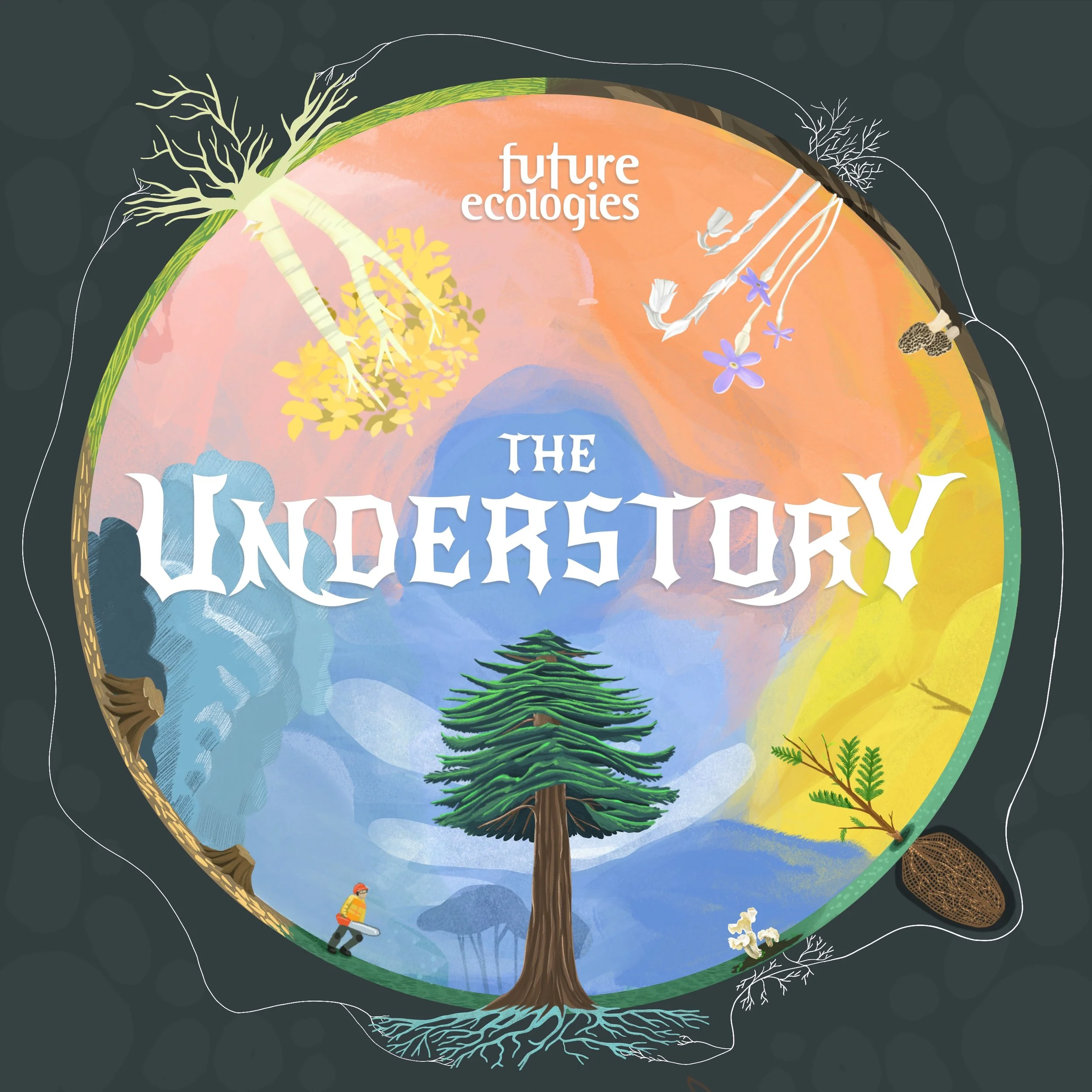
Cover artwork by Ale Silva
Catch each part of The Understory each week as it comes out at futureecologies.net/understory, or in your favourite podcast app
Want to get access to the whole series right now? Head to our Patreon.
The Wood Wide Web — AKA trees linked together through fungal networks — is an idea that has transformed the popular understanding of forest ecology. Thanks largely to the pioneering work of Dr. Suzanne Simard, western science has begun to evolve from seeing forests as composed of competing individuals towards seeing them as an alloy of competition and cooperation: an interdependent whole that’s more complex than we could possibly have imagined.
But as the general public became increasingly enchanted with the idea that trees can “talk” to each other, “share” nutrients and resources, or even “nurture” their offspring, parts of the scientific community started to question if current evidence is really strong enough to support those claims — resulting in an unusual debate which is as much about science as it is about storytelling.
In The Understory, a 5-part limited series from Future Ecologies, we uncover the roots of the controversy, dig deep into the ancient relationships at the heart of the forest, and branch out to ask what it all means in the context of contemporary industrial forestry.
You can subscribe to and download Future Ecologies wherever you find podcasts - please share, rate, and review us. We’re also on Facebook, Instagram, Twitter, and iNaturalist.
If you like what we do, and you want to help keep it ad-free, please consider supporting us on Patreon. Pay-what-you-can (as little as $1/month) to get access to bonus monthly mini-episodes, stickers, patches, a community Discord chat server, and more.
Future Ecologies is recorded and produced on the unceded, shared, and asserted territories of the WSÁNEĆ, Penelakut, Hwlitsum, and Lelum Sar Augh Ta Naogh, and other Hul'qumi'num speaking peoples, otherwise known as Galiano Island, British columbia, as well as the unceded, shared, and asserted territories of the Musqueam (xwməθkwəy̓əm) Squamish (Skwxwú7mesh), and Tsleil-Waututh (Səl̓ílwətaʔ/Selilwitulh) Nations - otherwise known as Vancouver, British Columbia.