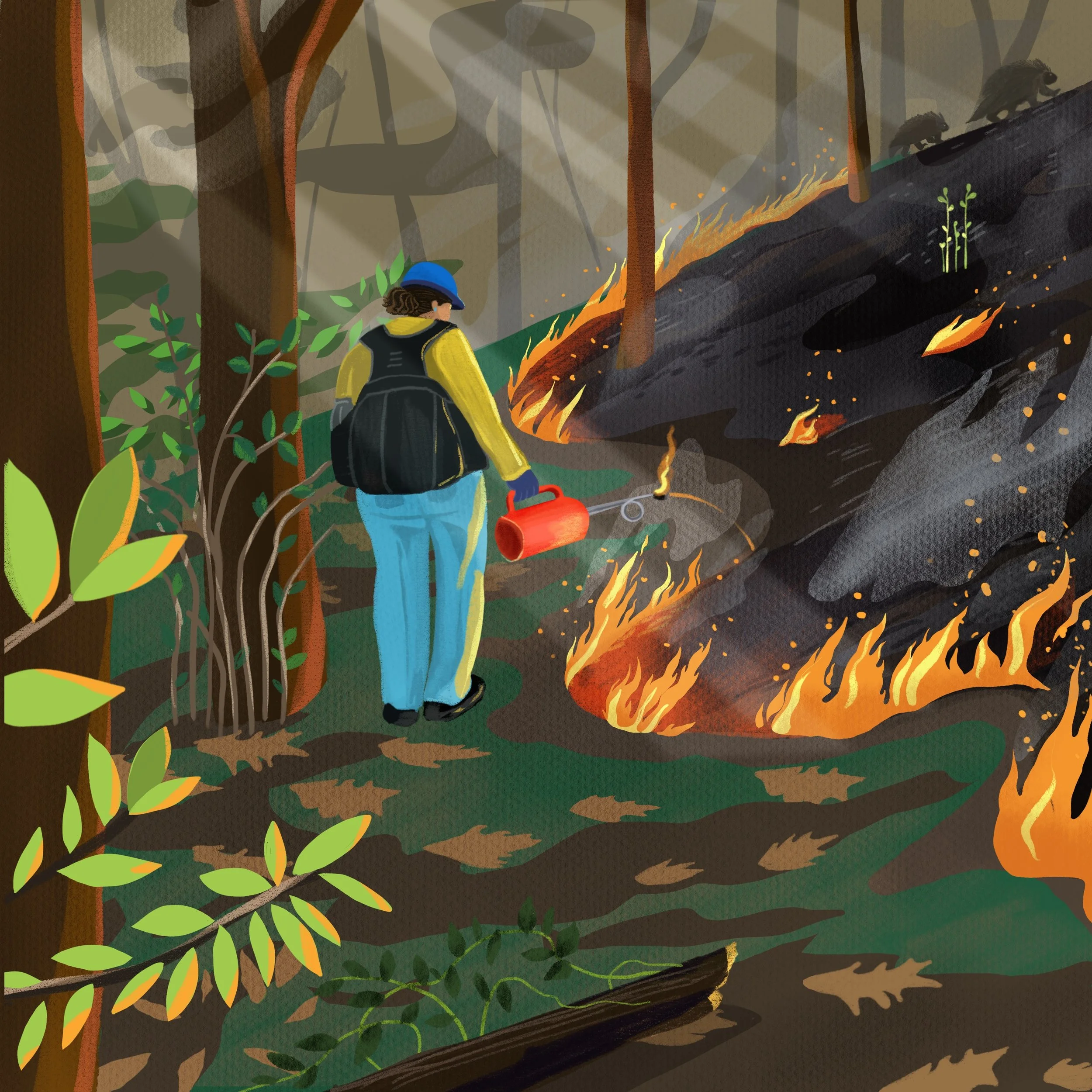
Another 🔥 cover artwork by Ale Silva
So you want to put good fire on the ground, but how?? We're taking you to Yurok territory, at the mouth of the Klamath River, to join the Cultural Fire Management Council for 3 days of burning — not just for fuel management, but for all sorts of cultural and ecological values: food, wildlife, materials, and more. We're finally moving from theory to practice, as we learn what it really means to be on the fire line.
This is our 6th return to the subject of fire. Call us obsessed, but we can't think of a better symbol for what this podcast is all about: demonstrating how people can (and need to) be active stewards of their ecologies, rather than passive victims of collapse. In fire-evolved ecosystems all over the world, prescribed fire has been an ecological management tool since time immemorial.
Ongoing support for this podcast comes from listeners just like you. To keep this show going, join our community at patreon.com/futureecologies
Our supporters get access to early episode releases, a community discord server, discounted merch, and exclusive bonus content.
Show Notes and Credits
This episode was recorded and reported by Adam Huggins, and was edited and produced by Mendel Skulski
Learn more about the CFMC at https://www.culturalfire.org/
This episode features the voices of (just some of) the CFMC crew. In order of appearance: Elizabeth Azzuz, Dylan Stevens, Rick O’Rourke, Margo Robbins, Robert McConnell, Annelia Norris, Isabel Guerra, Amanaka Yancey, Jordan Spannaus, Claire Brown, Max Brotman, and Will Bruce.
Plus music by C. Diab, Thumbug, Adrian Avandaño, G̱a̱mksimoon, and Sunfish Moon Light
With special thanks to the Confluence Lab's inaugural Artists-in-Fire Residency (Sasha White especially). Thanks as well to Fern Purdy, and Anita & Micah Williams. Adam wrote a blog post for the Confluence Lab about his experiences at the CFMC.
Catch up on all our other episodes On Fire:
Plus three related episodes:
This episode includes audio recorded by daveincamas, planman, yellowbear, charlenez, lunchmoney, stubb, nagwense, musicvision31, alec_havinmaa, mateusz_chenc, leavidencedesign, lucish, trp, jonsept, kyles, sushiman2000, sushiman2000, mariannadeoliveira, qubodup, marokki, omsatalkar, jelloapocalypse, artninja, accessed through the Freesound Project.
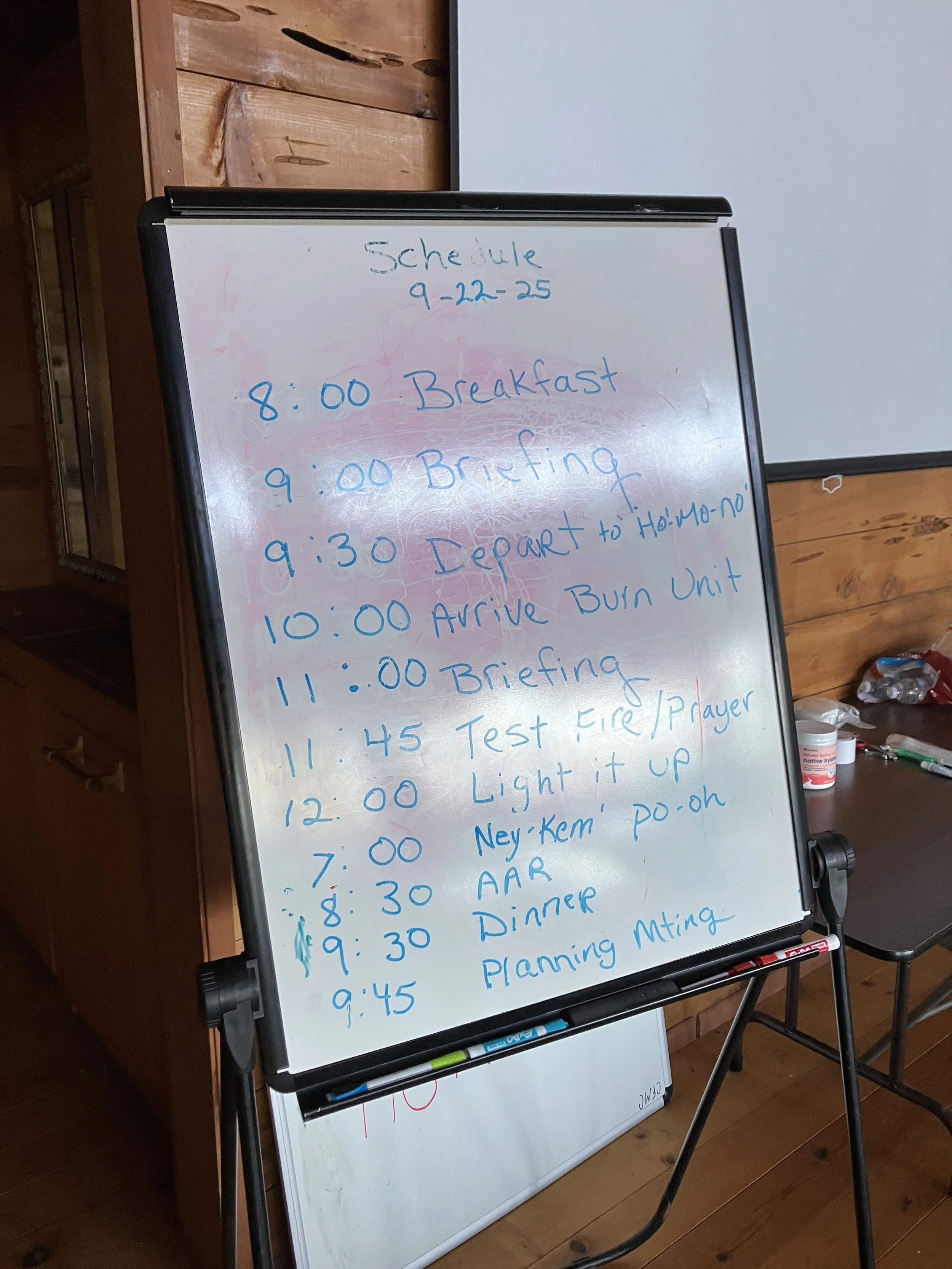
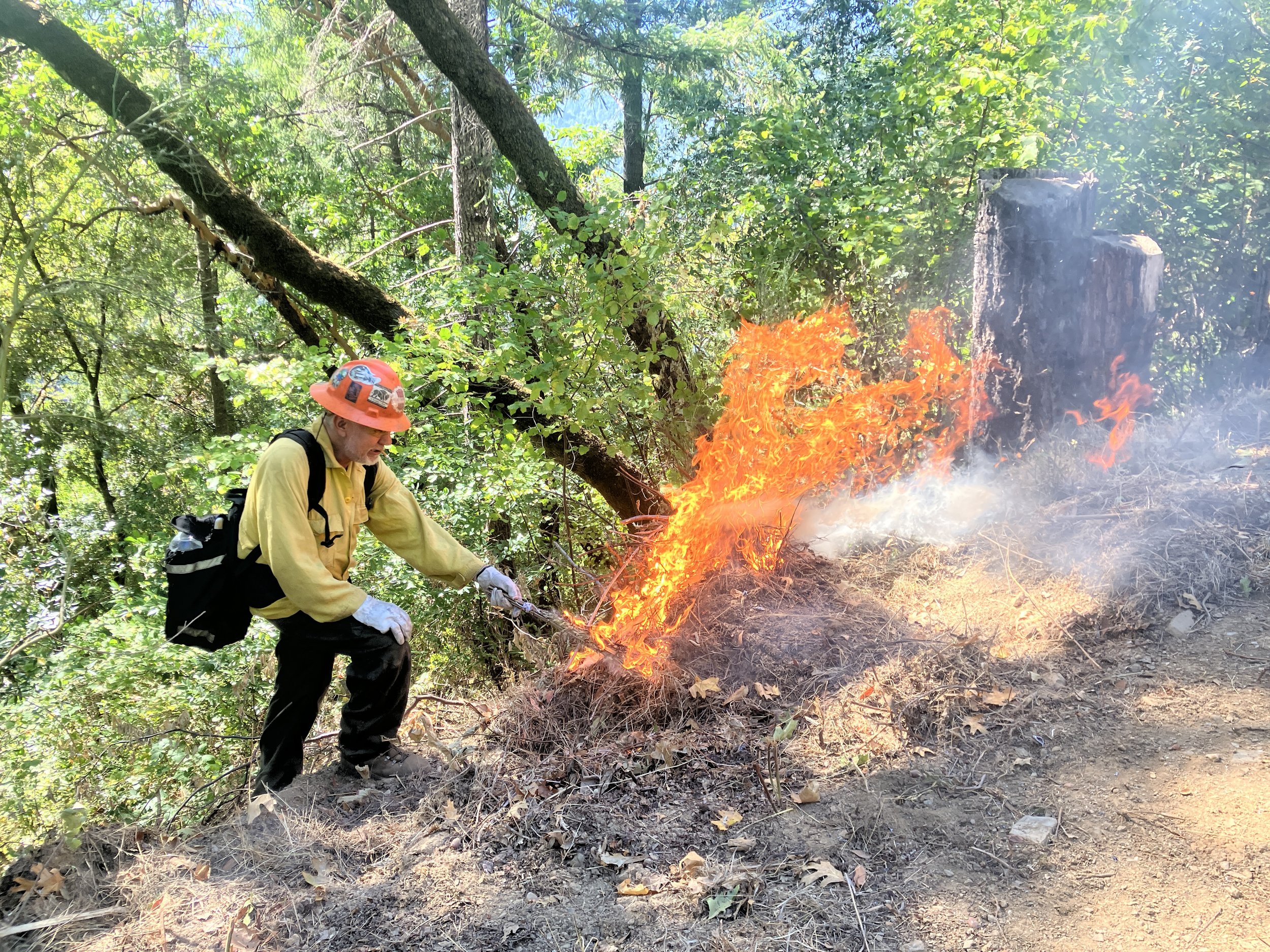
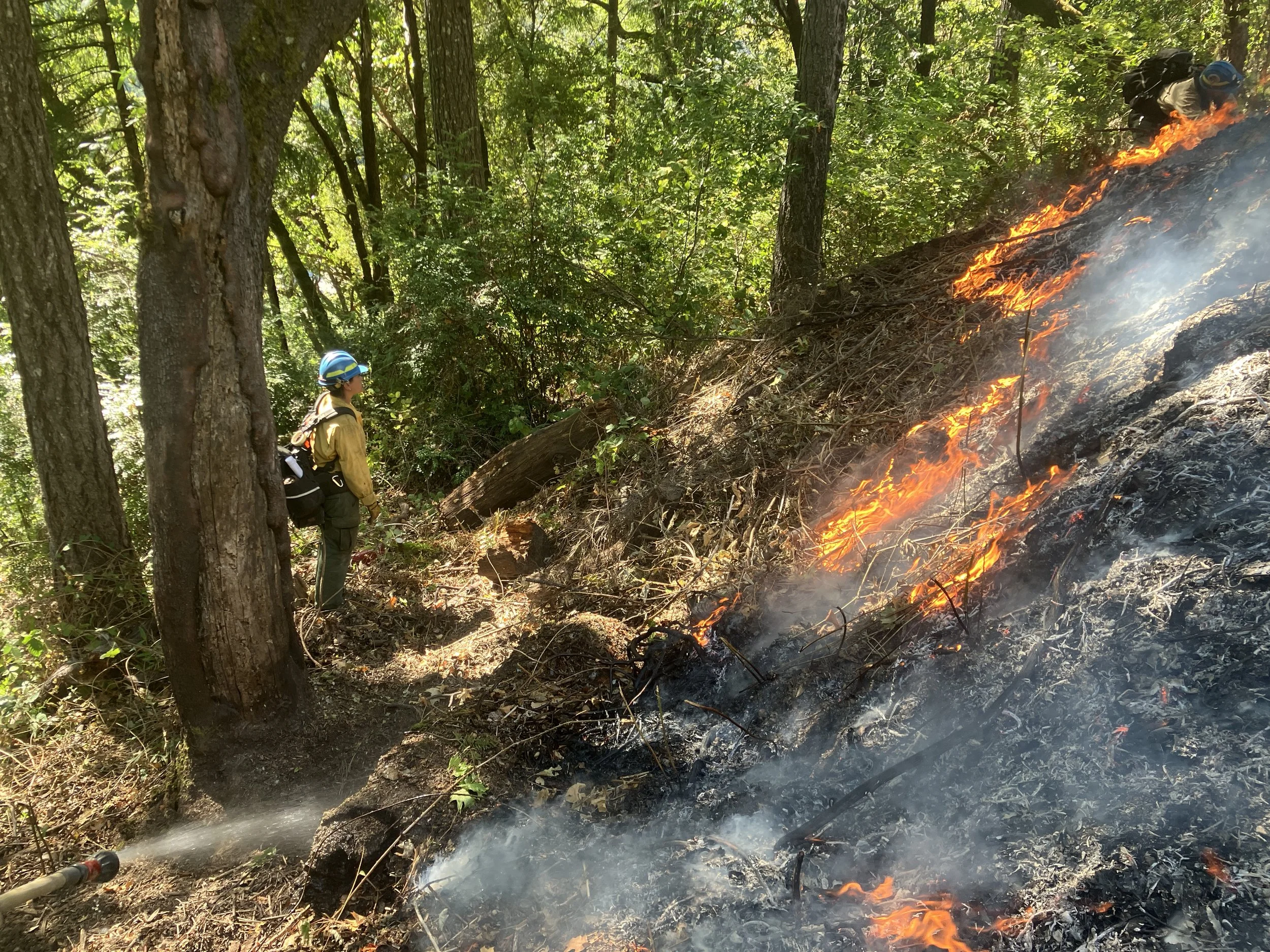
Photos

Citations
Cagle, S. (Nov 21, 2019) 'Fire is medicine': the tribes burning California forests to save them, The Guardian
Halpern, A. A., Sousa, W. P., Lake, F. K., Carlson, T. J., & Paddock, W. (2022). Prescribed fire reduces insect infestation in Karuk and Yurok acorn resource systems. Forest Ecology and Management, 505, 119768. https://doi.org/10.1016/j.foreco.2021.119768
Kim, S. E. (Nov 24, 2025) The West’s vanishing porcupines, High Country News
Lake, F. K., Wright, V., Morgan, P., McFadzen, M., McWethy, D., & Stevens-Rumann, C. (2017). Returning Fire to the Land: Celebrating Traditional Knowledge and Fire. Journal of Forestry, 115(5), 343–353. https://doi.org/10.5849/jof.2016-043R2
Long, J. W., Lake, F. K., & Goode, R. W. (2021). The importance of Indigenous cultural burning in forested regions of the Pacific West, USA. Forest Ecology and Management, 500, 119597. https://doi.org/10.1016/j.foreco.2021.119597}
Marks-Block, T., Lake, F. K., Bliege Bird, R., & Curran, L. M. (2021). Revitalized Karuk and Yurok cultural burning to enhance California hazelnut for basketweaving in northwestern California, USA. Fire Ecology, 17 (1), 6. https://doi.org/10.1186/s42408-021-00092-6
Yurok Cultural Fire Stewardship Plan (Apr 24, 2024) Skey-wok kee'we Mech "It Needs Fire", ArcGIS Storymap
Yurok People (Apr 11, 2024) Ner'-er-nerh • Pue-leek-laa' • Pey-cheek-laa', ArcGIS Storymap
You can subscribe to and download Future Ecologies wherever you find podcasts - please share, rate, and review us. We’re also on Facebook, Instagram, Twitter, and iNaturalist.
If you like what we do, and you want to help keep it ad-free, please consider supporting us on Patreon. Pay-what-you-can (as little as $1/month) to get access to bonus monthly mini-episodes, stickers, patches, a community Discord chat server, and more.
Future Ecologies is recorded and produced on the unceded, shared, and asserted territories of the WSÁNEĆ, Penelakut, Hwlitsum, and Lelum Sar Augh Ta Naogh, and other Hul'qumi'num speaking peoples, otherwise known as Galiano Island, British columbia, as well as the unceded, shared, and asserted territories of the Musqueam (xwməθkwəy̓əm) Squamish (Skwxwú7mesh), and Tsleil-Waututh (Səl̓ílwətaʔ/Selilwitulh) Nations - otherwise known as Vancouver, British Columbia.
Transcription
Introduction Voiceover 00:01
You are listening to Season Six of Future Ecologies.
Elizabeth Azzuz 00:08
I, as a four year old, got caught playing with matches by my grandfather, my Karuk grandfather. And he decided that I needed to learn my responsibilities to the mother if I thought I could play with fire. And so here started my journey. I have always burned with my family, pretty much rogue or illegally, you would say, just because that was how we were able to maintain our gathering grounds and our hunting grounds and our food sources and materials that our women needed. And so I learned that fire was a tool, not a toy, and that fire gives us our foods and our medicines, and it purifies our water. You know, it helps all living beings in the forest and in the rivers. You know, out there, you're taught to fear everything. Here we're taught to live with everything.
Adam Huggins 01:08
Hi Mendel.
Mendel Skulski 01:09
Hey, Adam. Who was that?
Adam Huggins 01:11
That was Elizabeth. I was interviewing her in her fire engine. But we'll get to all that. Mendel, I am so freaking excited to tell you about what I've been up to.
Mendel Skulski 01:23
What have you been up to?
Adam Huggins 01:25
Oh, ever since you and I first started this podcast, we have been, I think it's fair to say, a little bit obsessed with fire.
Mendel Skulski 01:33
A little bit?! We've done, like five episodes on fire... so far.
Adam Huggins 01:36
That's right, the very first pilot episode that we made together was all about fire. Since then, we have interviewed Indigenous Fire Keepers, permaculturalists, researchers, firefighters...
Mendel Skulski 01:51
Rogue landowners who refuse to evacuate.
Adam Huggins 01:54
And we've visited areas that have been burned intentionally. We've visited areas that have been burned unintentionally in catastrophic wildfires. I feel like we've done just about everything except actually participate in lighting some of those fires ourselves.
Mendel Skulski 02:11
Today's the day! Enough talk, more walk.
Adam Huggins 02:15
Exactly.
Mendel Skulski 02:15
So how are we going to make that happen?
Adam Huggins 02:18
So to be honest with you, even after having all these conversations, I was thinking about fire in a pretty theoretical way. And then this opportunity came up. I was invited to apply for this brand new experimental artist in residency program that was offered from a place called the Confluence Lab at the University of Idaho, Mendel.
Mendel Skulski 02:41
Okay?
Adam Huggins 02:41
I applied, and surprisingly, was accepted.
Mendel Skulski 02:45
Hey, you're an artist!
Adam Huggins 02:47
Yeah, podcasters are artists, right?
Mendel Skulski 02:50
We are.
Adam Huggins 02:51
So I became one of the 10 inaugural Artists in Fire.
Mendel Skulski 02:56
Congratulations.
Adam Huggins 02:57
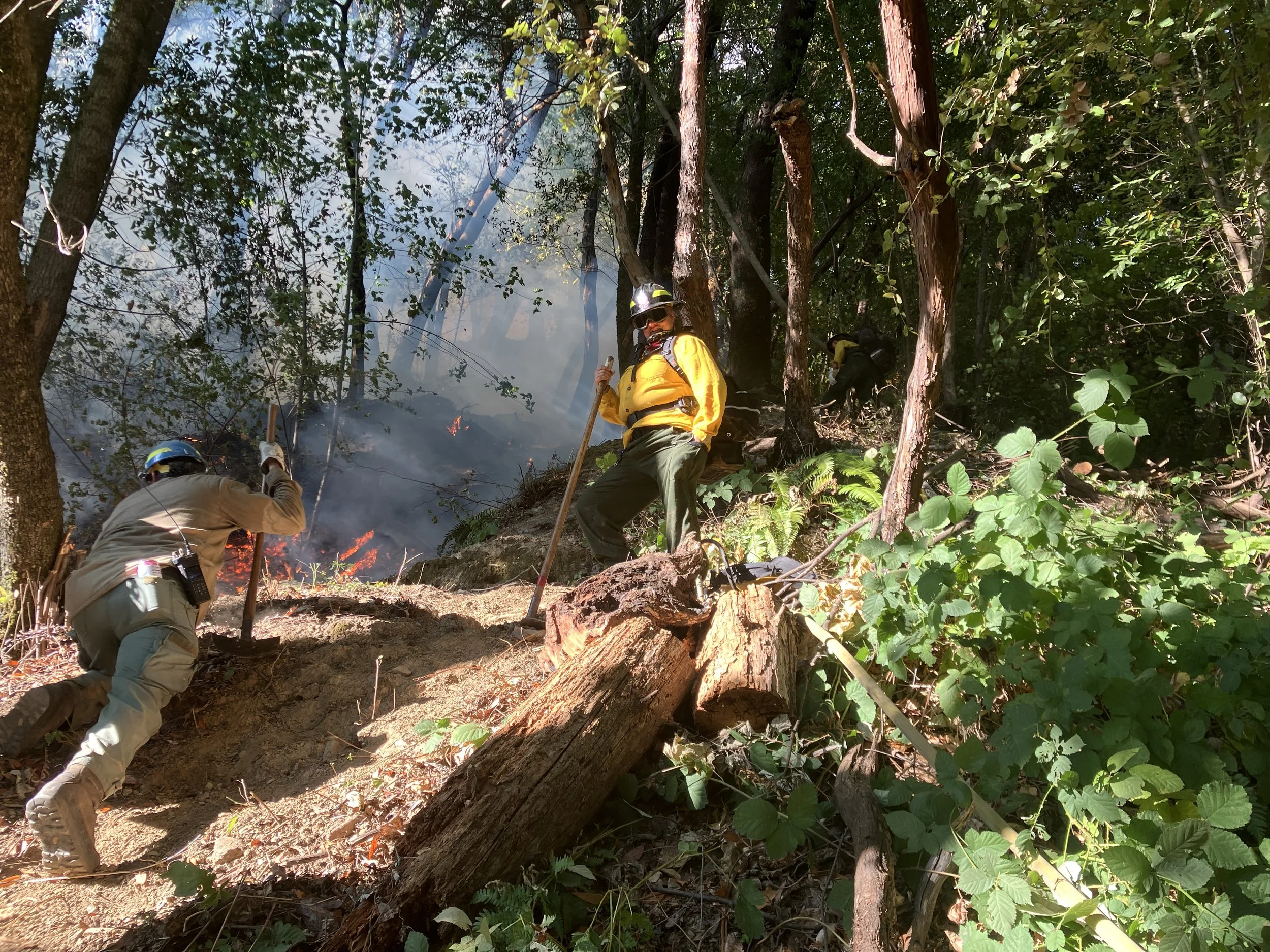
Thank you. Appreciate that. That meant that I had to get myself on the fire line, and quick. So I took a handful of online courses with strange acronyms and bought myself a very expensive new pair of leather boots, did a field day and pack test. and that's how I found myself standing in the middle of a narrow, one lane road at the top of a seemingly vertical slope covered in dense brush, and wondering to myself just how in the hell we were gonna pull this burn off.
Dylan Stevens 03:32
What's your burn experience like?
Adam Huggins 03:34
None.
Dylan Stevens 03:35
Cool.
Adam Huggins 03:35
I am amazed at how like steep this site is, and how much like material there is still on the ground.
Dylan Stevens 03:43
You're like, Whoa, there's a lot of fuels on the ground, and it's steep.
Adam Huggins 03:46
Yeah, yeah, yeah, that's my impression.
Dylan Stevens 03:49
Yup. Welcome to the Klamath.
Mendel Skulski 03:52
The Klamath! We passed through there back in season one. It is... steep.
Adam Huggins 03:59
It's very hilly, yes. When I lived there for a year, way back when, I was up river in Karuk territory. But this time, I went down river — for the very first time, actually — to Yurok territory, which is near the mouth of the Klamath River, where it lets out into the Pacific Ocean. It's about as rural and rugged as it gets, twisting, unpaved roads, scattered settlements and mountainous terrain. The hillsides are steep but green. They're covered in Douglas fir trees. The river is beautiful and wild because, very recently, the last remaining dams were removed. That's a story for another day, but an incredible one. And so what you're gonna hear in this episode is sort of a medley of voices of all of the different people I spoke to while I was there, the crew members who are bringing good fire back to the land in this part of the world.
Adam Huggins 04:57
That's pretty steep, man...
Rick O'Rourke 04:58
Yeah.
Adam Huggins 04:59
We're gonna burn this?
Rick O'Rourke 05:00
Yeah, this is the black.
Adam Huggins 05:02
Holy smoke.
Adam Huggins 05:03
And you know what? Mendel, we burned that slope.Aand then we burned 30 acres over the next three days.
Mendel Skulski 05:10
Hell yeah.
Adam Huggins 05:11
From Future Ecologies, the sixth entry in our seemingly never ending series “On Fire”, This is Out of the Green, Into the Black
Introduction Voiceover 05:26
Broadcasting from the unceded, shared and asserted territories of the Musqueam, Squamish, and Tsleil-Waututh, this is Future Ecologies – exploring the shape of our world through ecology, design, and sound.
Adam Huggins 06:08
Okay, so a little bit of background. The Cultural Fire Management Council, or the CFMC, is a Yurok-led, community-based nonprofit organization with a stated mission to facilitate the practice of cultural burning on the Yurok reservation and ancestral lands, which will lead to a healthier ecosystem for all plants and animals, long term fire protection for residents, and provide a platform that will in turn support the traditional hunting and gathering activities of Yurok.
Robert McConnell 06:38
The objective is just to restore fire to this place, right? This is the home of Rick's people and many others of the Morek village here, just right up this way. Right, Rick?
Rick O'Rourke 06:50
Yeah.
Adam Huggins 06:51
this is Rick O'Rourke. He was around since the very beginning of the CFMC. He's an old hand, and we were burning on his family's land.
Adam Huggins 06:59
What'd you call it? Morek?
Rick O'Rourke 07:00
Morek, yeah.
Adam Huggins 07:01
And that was the village site?
Rick O'Rourke 07:02
Yes. Bones of my ancestors from the beginning of time are there.
Annelia Norris 07:07
It means a lot to me to be able to burn the place where I live.
Adam Huggins 07:11
You said we're gonna burn around your place?
Annelia Norris 07:14
Yeah, tomorrow, I guess.
Adam Huggins 07:15
Yeah. Is that right? Like, just your neighborhood, or, like, literally, like, where your house is?
Annelia Norris 07:19
Robert said in my backyard.
Isabel Guerra 07:21
There's no other crew like the one that we have here and that we're building here with cultural Fire Management Council.
Amanaka Yancey 07:27
I've grown up in fire here. Now that I've gone out on wildfires and like burned with other prescribed burn crews, I realize like, how freaking special this is, and also how vastly different, like burning objectives can be.
Adam Huggins 07:43
Yurok territory is like everywhere else in North America, in that Indigenous stewardship of landscapes was criminalized for generations. California banned Indigenous cultural burning in 1850
Elizabeth Azzuz 07:58
I was raised to learn that the red and green trucks probably wouldn't shoot a child,
Adam Huggins 08:03
The red and green trucks being those of the California Department of Forestry and Fire Prevention and of the National Forest Service, respectively.
Elizabeth Azzuz 08:11
But they would shoot or arrest adults for using fire.
Adam Huggins 08:16
And it wasn't until well into the last century that burning became a practice that would not potentially get you killed, and I think that's just something that's really important to recognize. People put their lives on the line to keep this knowledge alive so that their descendants would be able to steward their territory as intended.
Elizabeth Azzuz 08:36
We're just here to take care of the land, take care of the people.
Jordan Spannaus 08:40
Restoring our land how it used to be before we weren't allowed to burn.
Adam Huggins 08:47
One thing that they've been able to learn from comparing historical aerial photographs with what things look like now is that they have lost something like 96% of their open prairie ecosystems.
Rick O'Rourke 09:03
Well, with no fire for 130 years, the encroachment of the conifers onto our prairies, it just happens fast. As well as the Forest Service and agencies like that having them planted with trees and the subsequent removal of the porcupines, which one of their main staples is the little firs.
Adam Huggins 09:30
Oh, so the porcupines help keep the firs down.
Rick O'Rourke 09:33
Yeah, that help with the encroachment.
Adam Huggins 09:35
Really?
Rick O'Rourke 09:36
Yeah.
Adam Huggins 09:37
They eat them?
Rick O'Rourke 09:37
Yes, that's one of their main parts of their diet.
Adam Huggins 09:40
And what do you mean by the removal of the porcupines?
Rick O'Rourke 09:44
I think they poisoned them or something like that.
Adam Huggins 09:49
Yeah, this hit me way out of left field. I had no idea that we are in the middle of a complete collapse of the porcupine population. And that is from up here in Canada all the way down the coast. It turns out porcupines helped regulate the in growth of trees like Douglas fir, because they like to munch on them like any good rodent does. The sad reality is that they were treated like many rodents. They were singled out as a threat to the forestry industry, and so for generations, these creatures were poisoned. They were shot. And killing porcupines was encouraged by both government and industry.
Adam Huggins 10:38
Several decades ago, we stopped killing porcupines on purpose, generally, as a society, but their populations have not really recovered. So in many ways, the work of the CFMC is to undo the damage from the policies put in place by the Forest Service.
Adam Huggins 10:56
When I was talking with folks on the crew who were older, they were telling me that when they were young, you could look across the river and look down slope and see all the way through because the forest was open. It was full of deciduous trees. It wasn't packed densely with conifers. Is this starting to sound familiar now? And so there's just no question that the lower Klamath used to be a mosaic of ecosystems which included some coniferous forest, but also included these large areas of oak woodland and Prairie and grassland, and that the Yurok people stewarded these areas with fire to have the full range of foods and medicines and materials for their cultural practices.
Margo Robbins 11:44
Well, a lot of people just burn for what they call hazardous fuel reduction, but we're burning to restore the land.
Claire Brown 11:53
It's step one of an intergenerational, iterative restoration process. Yep, day one — coming!
Adam Huggins 12:00
Day one for me too.
Adam Huggins 12:01
And this is something that, many folks told me, sets the CFMC apart from other burn crews. Their goals are as much about cultural resources as they are about consuming the fuel.
Elizabeth Azzuz 12:13
You sometimes could get an agency person that's just like, oh, let's just burn, burn, burn. We'll slow down. You know, things need to be done a certain way.
Adam Huggins 12:22
That's Elizabeth again, Elizabeth Azzuz. She's a founding board member of the CFMC, and she drives the fire engine known as 111.
Elizabeth Azzuz 12:31
We're in someone else's home right now, you know, and so we try to be respectful when we do that, we ask permission from the land and the animals and the trees to come into their home and do this. Government agencies don't do that. You know, it's all about the acres. Get it done. Get it done fast.
Adam Huggins 12:48
You know, the thing about prescribed fire, about cultural fire, is that you can only do it under very specific weather and environmental conditions. And so when there is a good burn window, the CFMC is on it, and they are taking advantage of every last minute that they have during that burn window to get as much good fire on the ground as possible.
Robert McConnell 13:09
We don't want to impact the values down here, which is the water system.
Adam Huggins 13:13
And before a fire, there's always a briefing. When the CFMC was first getting started, they had to rely on non-Indigenous burn bosses, because they didn't have anyone locally who had that designation, who had those skills. But now they have Robert, Robert McConnell,
Robert McConnell 13:28
so we're not getting any of those petroleum products near their drinking water, which is right there.
Adam Huggins 13:33
And at the end of every briefing, Robert would say,
Robert McConnell 13:37
Go forth. Have fun. Be safe. Look out for each other, learn something,
Adam Huggins 13:42
have fun, be safe, learn something. And that was exactly what we did.
Adam Huggins 13:50
So to kick off the real work of day one, we had to prep the site. I helped clear gutters and move brush away from a nearby home that we were gonna burn — not the home, like, burn to the home.
Mendel Skulski 14:04
I should hope!
Adam Huggins 14:04
Yeah, other squads were blowing leaves around with a leaf blower, checking and charging the water lines, getting all the gear lined up, you know, weed whacking the grass on the side of the road, like all this activity. And then everybody comes together. We're back at the top of the slope, and folks are goofing around...
CFMC crew 14:21
By our powers combined... wind, water, fire, earth, heart!
Adam Huggins 14:32
Do you know what we're waiting for?
Claire Brown 14:33
Test fire.
Adam Huggins 14:33
Test fire.
Adam Huggins 14:34
And when everyone is present and accounted for, it was Rick who stepped forward to light the test fire on his family's land. He took a lighter to this beautiful, long, silver bundle of Wormwood that they used to start the fire, and he murmured a prayer while lighting up a patch of ground.
Rick O'Rourke 14:56
Creator, look after all of our People who are here do your service, helping heal our land, heal our people, bring back our animals, create balance. It's an honor.
Adam Huggins 15:15
Can I ask you a question about the test fire?
Margo Robbins 15:18
Yeah.
Adam Huggins 15:19
Every time you guys do the test firing, everybody gathers around. There's a prayer, there's song. What's the like, what's the importance of that moment?
Margo Robbins 15:27
What's the importance of prayer? [Laughs]
Adam Huggins 15:29
Yeah, like, what, you know, it's not how, like, a typical, you know, prescribed burn starts.
Adam Huggins 15:34
This is Margo Robbins. She runs the show at the CFMC. She's the executive director.
Margo Robbins 15:39
Fire is medicine on the land, and when you smell that Wormwood, it makes it even more real. It takes it from a mind-knowing thing to a deep down heart-felt thing, and it helps us connect to that spiritual part of who we are and to connect to the things around us.
Amanaka Yancey 16:07
Yeah, it's really helpful. I've been on other burns where that practice isn't held and it's just immediately a cortisol level spike, then go... into this really like dangerous experience with a bunch of different people. Some you've known, have worked with for a long time, some you're maybe just meeting, and that collective pause is really potent.
Adam Huggins 16:26
I totally felt that. Just taking a moment for everyone to align their intentions and spirits and also just to get our heads on straight, it was so valuable, especially to me as someone about to do something I'd never done before with people I did not know.
Rick O'Rourke 16:41
To me, putting fire down on the ground is like putting prayer on the ground. Really like seeing the land for what it is and how important it is. I mean, this land needs us as much as we need it, and we believe what we are doing is the right thing to help heal this spot, as well as sending out knowledge to help other spots start the same thing, you know, so we can all do our part.
Adam Huggins 17:08
The purpose of a test fire is to make sure that what we're seeing on our instruments, and what we're seeing in the weather report, and what we're seeing on the ground is actually conducive to the kind of fire that the burn plan calls for.
Rick O'Rourke 17:24
It's receptive!
Adam Huggins 17:26
Meaning that it burned really readily. Still within the parameters of the burn plan...
Rick O'Rourke 17:32
Think just dots will do it.
Adam Huggins 17:34
But all it took were the tiniest dots of fuel from the drip torch to get the fire going.
Adam Huggins 17:52
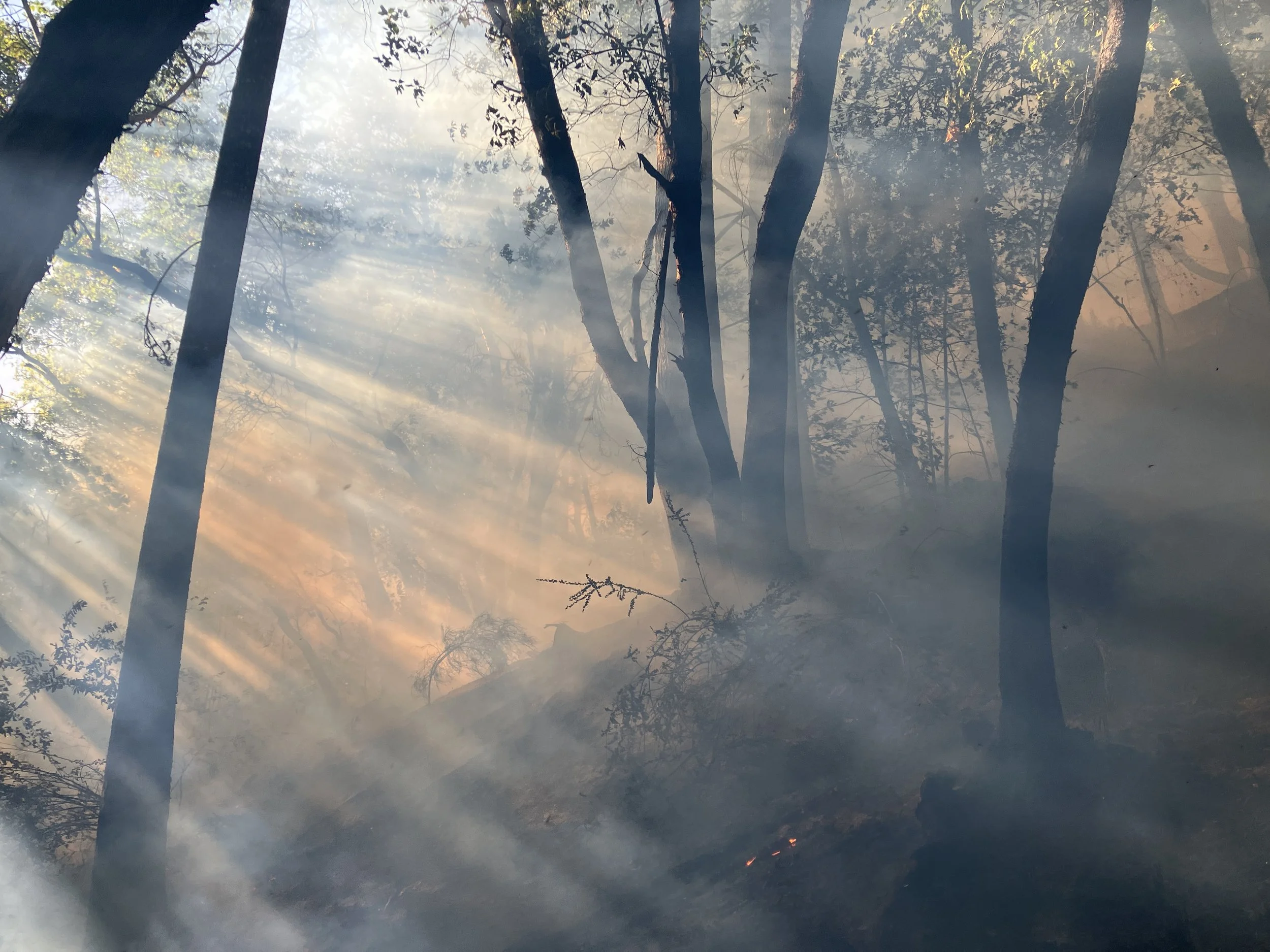
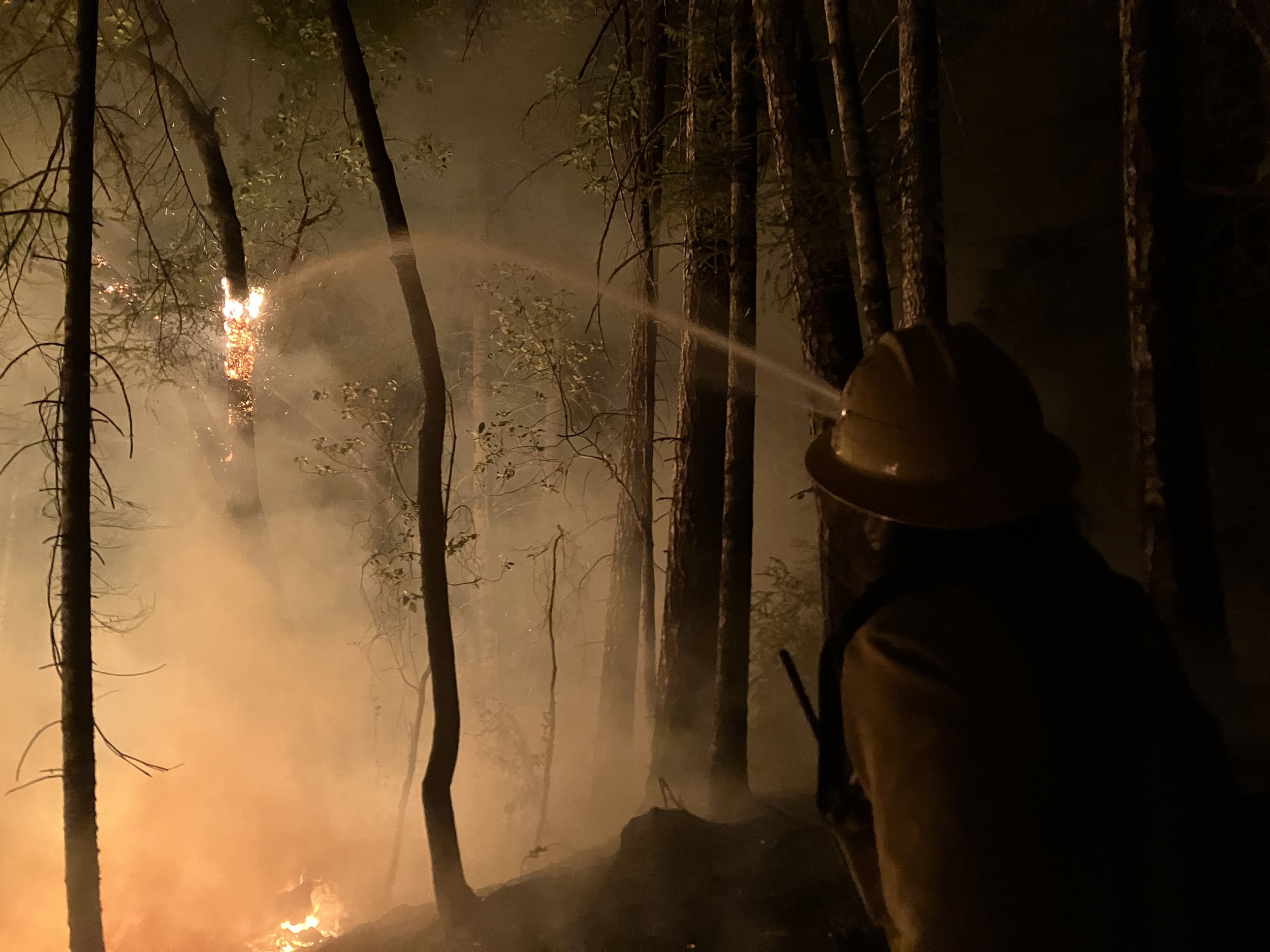
And with that, the whole crew kicked into gear, and I had to find my squad. Fire is running on the ground, and suddenly everything starts moving really, really fast. And oh man, did we get right into it. That fire started pretty hot, and so within minutes, I had a hose in my hand and was standing in thick smoke, putting water on some trees to prevent the fire from getting off the ground.
Adam Huggins 18:18
And I was getting a total crash course in fireline lingo. Are you ready for this?
Mendel Skulski 18:23
I think so?
Adam Huggins 18:24
All right, so on a fire line, you don't breathe smoke in, you eat it. And boy, I was eating smoke on day one. I was putting water on some logs on the ground to keep them from burning, because they just burn forever. Those are called heavies. and the whole crew took special care to inspect the bases of trees that they wanted to protect, like Oaks and Arbutus.
Max Brotman 18:47
Take extra care to look for cat faces.
Claire Brown 18:50
Will do.
Adam Huggins 18:51
They look for these injuries called cat faces, that if fire gets on them, it can burn the tree internally and cause issues. By the way, firefighters don't go anywhere. They bump.
CFMC crew 19:04
You want to go bump below the smoke and work with Amanaka for a bit?
Adam Huggins 19:07
I'm happy to.
Will Bruce 19:08
Alright — yeah go for it.
Adam Huggins 19:09
And you don't just bump your body around. You can bump things around too, like Jerries.
Will Bruce 19:15
Jerry!
Adam Huggins 19:16
Which are... cans of gas.
Annelia Norris 19:18
I was wondering who Jerry was.
CFMC crew 19:18
Oh yeah, bumping Jerry.
Adam Huggins 19:21
Or... piss pumps, which are backpacks full of water that you can use to make a nice stream. So you're walking on the slope and something gets dislodged and goes tumbling down, you're gonna yell really loud... ROCK!
Amanaka Yancey 19:38
Yeah, no matter what it is, if it's rolling down the hill — rock.
Adam Huggins 19:40
So there are different roles on a fire crew. The first role that I was assigned to was Holding, and holding has the responsibility of making sure that the fire does not escape. And so when you're on holding, you got to be looking out for spotting. Which is when little embers jump your line and get started. And jackpots, which are unburned patches of dense fuel that could explode. Fire can do so many things. It can crown, it can creep, it can back, and it can torch, which is when the fire starts climbing up into the tree canopy. And when that happens, if you're on holding, you've got to get some water on the fire and knock it down. And folks who are on holding are often on the sides and up along the top of the burn right. They're coming down as the burn is moving down the hill, keeping it contained.
Max Brotman 19:40
Rock! Little rock.
Claire Brown 19:41
Rock!
Adam Huggins 20:15
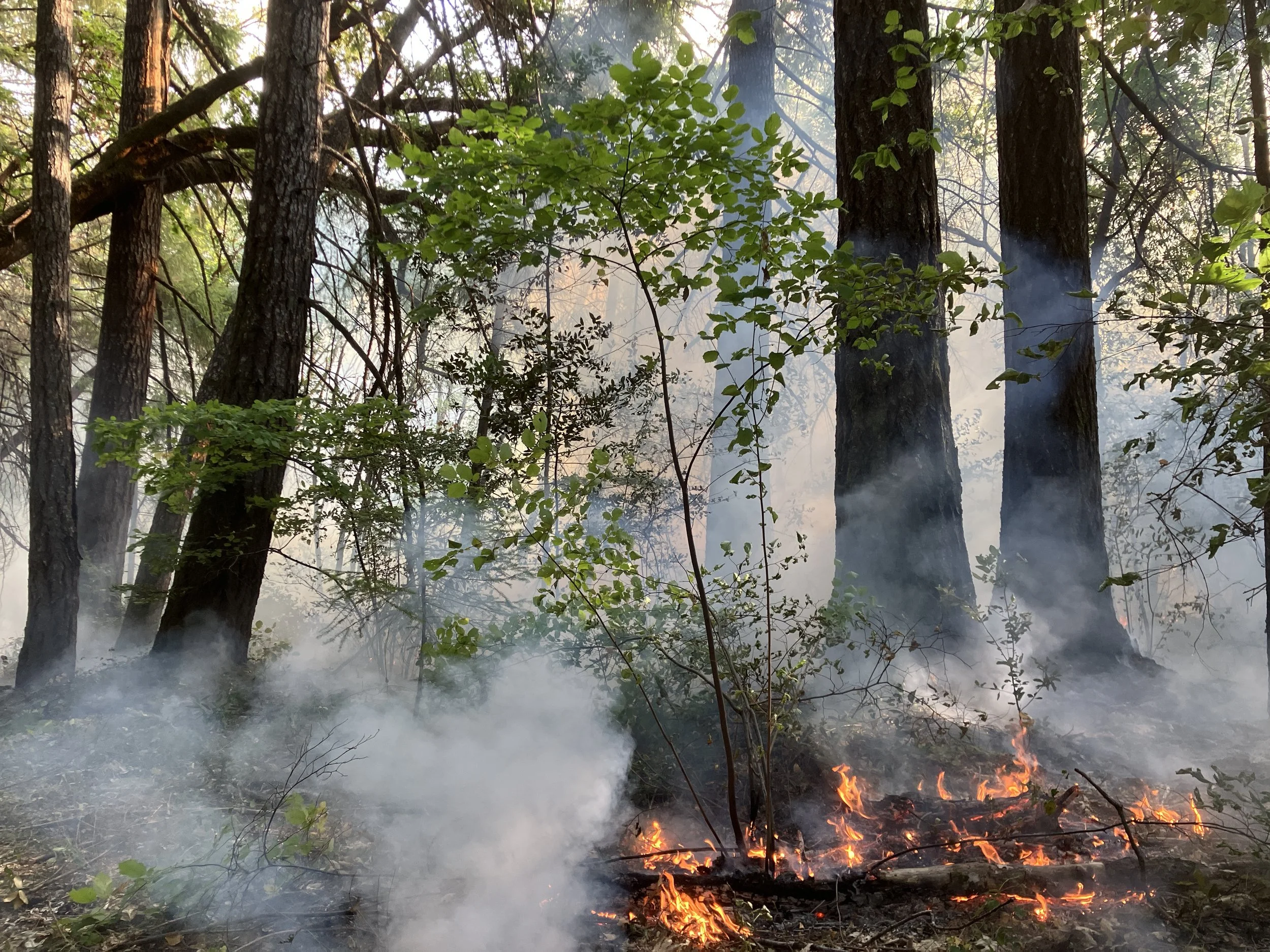
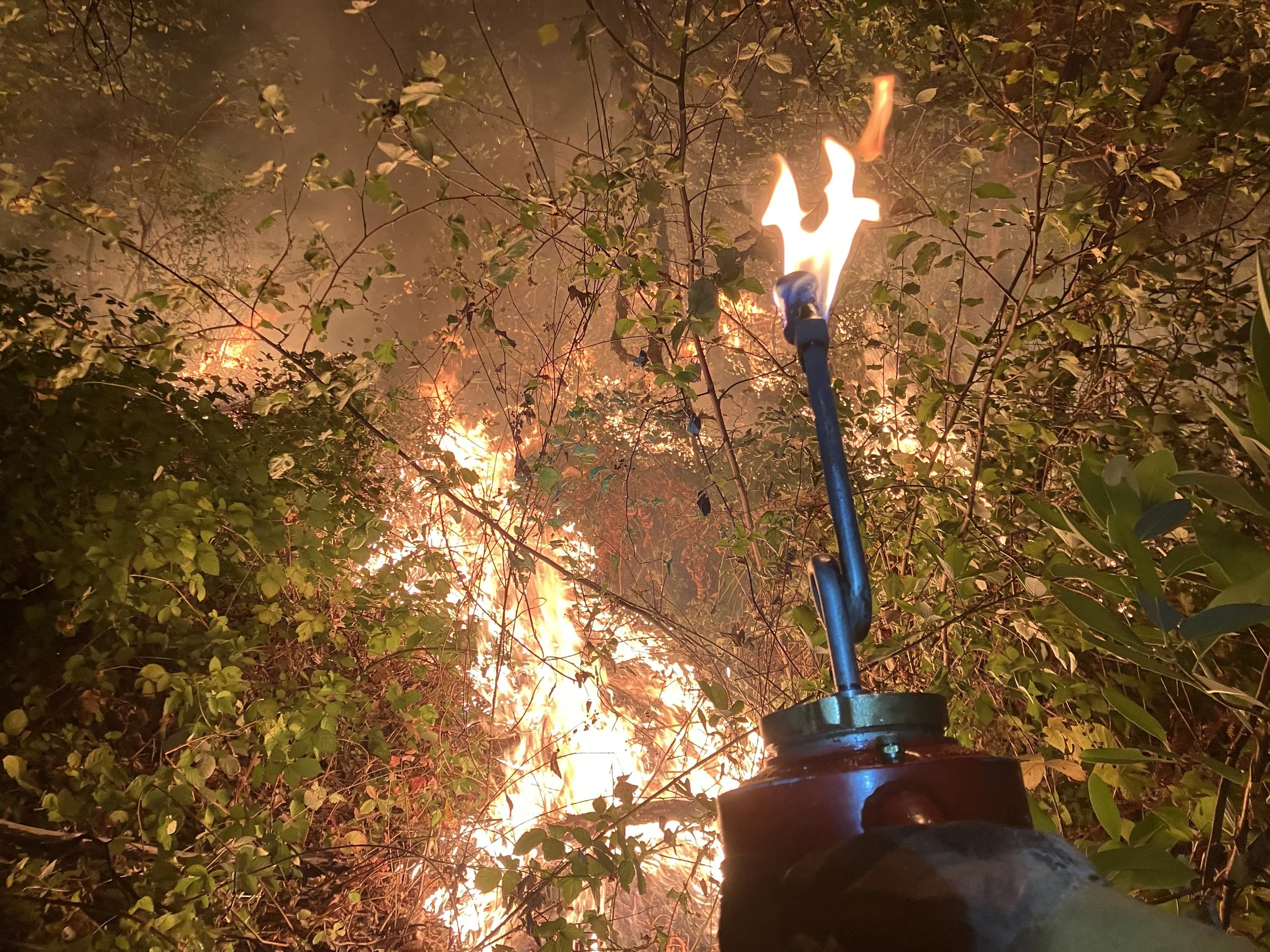
That's holding. And then there's Firing. The responsibility of firing is to bring the fire down a hill. They call it backing fire, and that's where the drip torches come in. A drip torch is a can of mostly diesel with a looping tube and a wick at the end. You light the wick, you swing the torch, and as drops of thick diesel exit the tube and pass over the wick, they become an arc of little flaming droplets. It's such a simple and satisfying tool to use, and like a paintbrush, you can use it to paint beautiful shapes on the landscape in fire — applying little dots if the fuel is really receptive, or making these long, wide arcs. In certain kinds of fuels, they'll make vertical streaks, and then those streaks will sort of burn together and meet. I learned that there's a real artistry to it, and a lot of knowledge that goes into how much fire you put down on the ground at any given time, and in what shape. Too much, and the fire can burn too hot and harm the things you're trying to protect, like a valuable old oak tree. But not enough, and the fire won't really move how you want. It'll kind of stay static. The experienced hands on the crew just sort of knew how to fire in each circumstance to get the effects that they wanted. Finally, you've got the Green and you've got the Black. The green is the unburned area outside of your containment lines, and you want to prevent that from catching fire. The black is the burned area inside your lines.
Amanaka Yancey 22:11
I'm seeing a little bit of wind coming up towards us with these embers. So while we're talking, maybe
Adam Huggins 22:15
You want to have an eye on the green over there.
Amanaka Yancey 22:18
We'll glance over our shoulder every now and then
Adam Huggins 22:20
You know you can keep an eye on the black. I'll keep an eye on the green.
Amanaka Yancey 22:23
Fantastic. Thank you.
Claire Brown 22:26
Temperature, 81, down 4. RH, 43 up 4.
Adam Huggins 22:33
That is the hourly weather report delivered by the FEMO, another acronym. Let's take a quick break from the smoke and check in with them, eh?
Mendel Skulski 22:42
Smoke break!
Adam Huggins 22:44
So FEMO stands for Fire Effects Monitoring, which is like a task, and also usually a person on this burn that was Claire Brown.
Claire Brown 22:54
Everybody gets to hear the trends through the day and build that picture in their own minds of like how they can expect things to be changing as the weather changes.
Adam Huggins 23:05
It's kind of like monitoring a patient during a procedure.
Claire Brown 23:07
It's like taking vitals exactly,
Claire Brown 23:14
PIG shaded 30, down 10.
Claire Brown 23:16
Our probability of ignition in the shade is 30.
Adam Huggins 23:18
30%?
Claire Brown 23:18
Yeah, 30% so if 10 embers landed on this fuel bed, we could expect three of them to catch.
Claire Brown 23:23
How do you copy?
Robert McConnell 23:24
Burn Boss copies, thank you.
Jordan Spannaus 23:27
Firing copies.
Max Brotman 23:28
Holding copies.
Claire Brown 23:30
One of the roles that FEMO has is the documentation that supports the burn boss legally, because we have a prescription in our burn plan and we have to have fire behavior that's inside of that prescription parameter. Like the burn boss needs to have a record of the weather for the day.
Adam Huggins 23:47
Every burn plan has these parameters, so the burn plan can only be executed if the conditions are correct. That's why there's constant monitoring. Is the temperature still appropriate? Is the moisture content of the fuel still appropriate? What is the wind doing? Is the wind going to start to create problems?
Adam Huggins 24:07
And I want to say yes, we were wearing the traditional outfits of firefighters. We had on our Nomex, we had fire engines, we had our tools. We looked for all the world like firefighters, but the context, to me, felt profoundly cultural. And this is something that many folks told me sets the CFMC apart from other burn crews. It's right there in the name, it's the Cultural Fire Management Council, and so cultural goals, cultural practices are front and center in this model of prescribed fire. This is first and foremost about community empowerment, and it's driven by cultural values related to the responsibility to the landscape and the relationship with the Creator. Cultural values related to what is a healthy landscape, what is a healthy forest, what is a healthy watershed? It encompasses everything from the movements of animals and how they will interact with the landscape down to the flow of water through the entire environment.
Rick O'Rourke 25:22
What we're doing is essentially creating a landscape wide water filter.
Elizabeth Azzuz 25:27
This time of year, right now, when we're burning, we know that the rain is coming, and so that's going to put everything to sleep. It's going to take this charcoal and ash filter clean water back into the water table, down into the creeks, into the river and into the ocean.
Adam Huggins 25:43
And cultural values for significant foods, medicines and materials... like beaked hazelnut.
Rick O'Rourke 25:52
With the canopy how it is now, those Hazels grow good — because, you know, they got that canopy. They're stretching long, straight sticks. That's what we're after. That's what the ladies are after.
Margo Robbins 26:04
All of those small bushes. That's Hazel. That's what we use for our baskets. So once the fire goes through, they'll send up new shoots.
Annelia Norris 26:12
Our name for Hazel is Holihl.
Adam Huggins 26:16
This is Annalia Norris, and when she's not lighting fires. She makes baskets.
Annelia Norris 26:22
Yeah, I'm a weaver. I've been making a lot of baby baskets because there's a high demand for thosoe.
Mendel Skulski 26:28
Like a tiny little basket for your baby to carry.
Adam Huggins 26:32
No, no! You put you put the baby in the basket!
Annelia Norris 26:37
Yeah, they're the safest way for our babies to sleep. You know, it kind of mimics the womb and that feeling so that babies feel secure, you know.
Adam Huggins 26:46
The Yurok are widely known for their baskets, for their variety, and their artistry, and their quality.
Annelia Norris 26:52
I've done some burden baskets, and I really enjoy that. That's like an open weave. We call them a kewoy — gathering basket, packing basket. But I also do some closed weave work, which is like your watertight baskets. And in this region, we're known for our watertight baskets. That's what we cook our acorns in. You know you have dipping baskets for your water, cooking baskets. And then we also have our really fine weaving, like our ceremonial caps and our, you know, tobacco baskets, trinket baskets, those kinds of things.
Adam Huggins 27:31
How... the material, like, why does it need to be burned to be good?
Annelia Norris 27:35
Well, it makes it stronger and more pliable. You know, when you burn the tops of these larger Hazels, and then new shoots can grow up. And then they grow nice and straight without, like, little stems coming off. So the burning helps to bring new shoots up, because that's what you're using, is the new shoots, right?
Adam Huggins 27:56
So, like, there's a hazel right behind you, and like, maybe you wouldn't use that so much because it's all kinky.
Annelia Norris 28:02
Yeah, because you don't want a crooked basket, you want a nice, straight stick.
Rick O'Rourke 28:05
You know, putting these sticks on the ground for our basket weavers is my way of giving back, like, to the dances, because these sticks are, like, so important. We keep our food in them, our babies, our medicine, we send up prayer with them. You know, without it, we wouldn't have been able to live here and thrive like we had.
Adam Huggins 28:25
The Hazel is just one element of Yurok basketry, but there's so much more to it.
Annelia Norris 28:30
We use the Blue Willow. We call that pergern. We also use spruce root, Sitka spruce. Spruce root is called 'wohpeg — that's what we use for our watertight baskets, because it expands when it gets wet. We use bear grasses, haamoh, we call it. We use the re' go', which is the maidenhair fern. The woodwardia fern, or pa'app'. We take out the insides of that and we dye it with Alder bark, and that makes the red in our baskets. We have yellow in some of our medicine baskets, and the yellow is porcupine quill that's called tegee'n, and we dye that with that yellow wolf moss.
Adam Huggins 29:16
Maybe you get the sense, Mendel, that it takes a whole healthy cultural landscape to make a single basket. They're burning for basketry materials, and they're burning for medicines, and they're burning for game. They're also burning to release oak trees so that oaks can be productive and produce acorns again. And then they're burning under those oak trees to prevent those acorns from getting infested with weevils. And by taking part in this cultural burning, Annelia is helping to restore that landscape.
Annelia Norris 29:47
It feels like the right thing to do, and I feel like I'm fulfilling my purpose as far as like taking care of the land where I'm living at and that's what we all should be doing wherever we live. It's like... caring for that landscape. We've normalized the cultural burning, like we've really taken leadership in asserting ourselves and our culture and our land management. You know, it just started catching, catching fire. No pun intended.
Adam Huggins 30:19
Oh, pun always intended over here. I'm sorry.
Adam Huggins 30:22
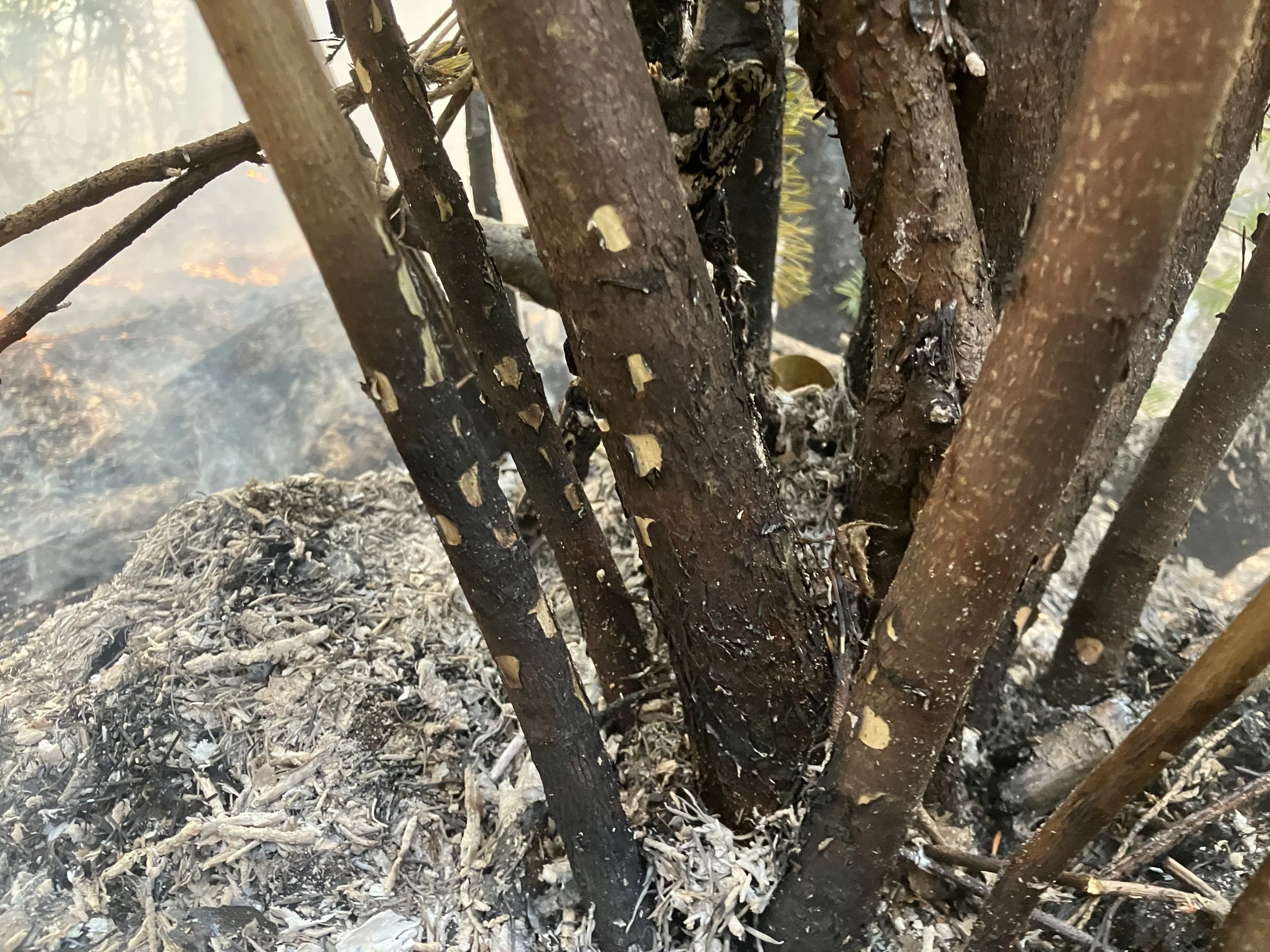
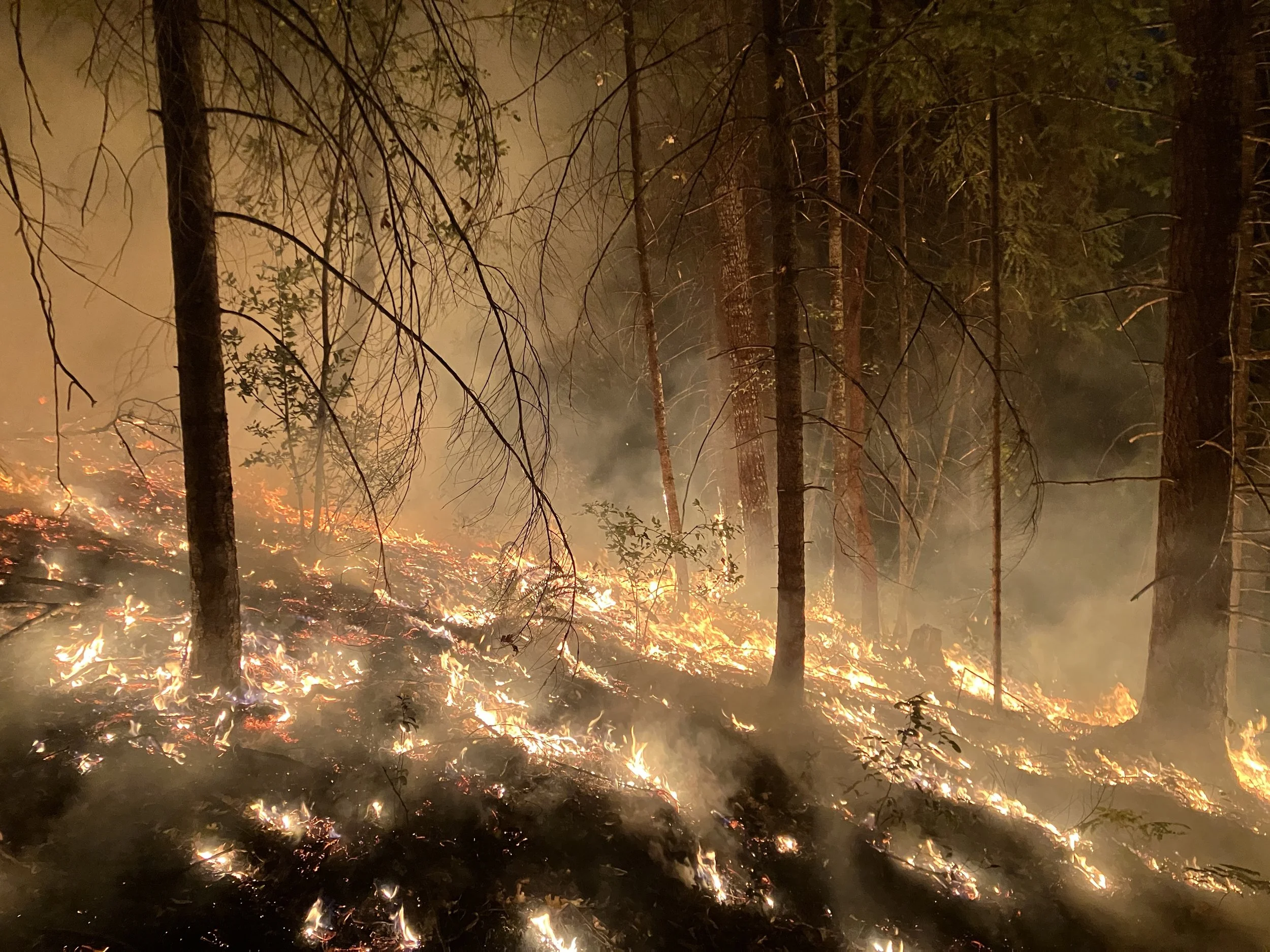
Because cultural values are driving everything that happens, because they're not just trying to burn off fuel, the burns look really different from what can sometimes happen on other prescribed fire crews, right? If your objective is just to burn off as much fuel as you can without lighting a wildfire on a piece of land, then you can burn through it really quickly, right? But for the Cultural Fire Management Council, they have so many values that they're trying to protect on the lands that they burn — that they're trying to protect and enhance, right? And so they need just the right fire intensity to where it's going to move through the ecosystem slowly, to where it's not going to kill the oak trees. It's going to provide blistering, but not completely kill off the Hazels.
Rick O'Rourke 31:08
It looks really good. The cambium blisters down at the bottom when you hit a certain heat point with this low intensity fire. It's a longer duration and lower intensity, and it blisters the cambium so that there's a top kill, and the new shoots for our baskets come up in the spring.
Adam Huggins 31:25
So you can tell that you're going to get good shoots absolutely just from the blisters.
Rick O'Rourke 31:35
Yes.
Adam Huggins 31:35
So I'm lying on my back in the tent first burn today. I am so tired. Today was little over two acres took something like seven hours. I'm told that tomorrow gonna take the same number of people and we're gonna burn 11 acres. Who knows how long that's gonna take? Anyway, Adam, day one of burning on the Klamath with the Cultural Fire Management Council... signing off.
Mendel Skulski 32:14
When we come back, day two, where we turn up the heat. That's after the break.
Mendel Skulski 32:47
Welcome back. I'm Mendel.
Adam Huggins 32:49
I'm Adam.
Mendel Skulski 32:50
This is Future Ecologies, and today, Adam is bringing us all along on his trip to Yurok territory on the Klamath River, so we can get a sense of what it's like to be on a cultural fire crew,
Adam Huggins 33:03
That's right. And on this particular crew, it was a really great mix of professional structure and then also flexibility. People were shifting roles, and it seemed like the leadership viewed every burn as an opportunity to give different people at different stages in their fire journey new experiences.
Isabel Guerra 33:27
Simply, I love it. I love how it pushes me. I love how I learn something new every day.
Adam Huggins 33:35
That's Isabel Guerra, the firing crew lead.
Isabel Guerra 33:37
One of the things I see in creating a learning environment is, yeah, you want to challenge people, but you also need to let them know that it's okay to fail, and it's not actually failure because you have your whole team holding on to you, creating that safety net.
Rick O'Rourke 33:53
I tell the people I'm training, I'll put you out of your comfort zone, but I won't put you in danger.
Isabel Guerra 33:58
Learning is such a sacred process.
Max Brotman 34:02
Fire is such a team effort. It's like a sports team. You know? It's like football. We like make our plan. We modify the plan as we go
Adam Huggins 34:09
Max Brotman — holding boss and drone operator.
Max Brotman 34:13
And I'm not a sports person, but I imagine it's like playing football.
Claire Brown 34:18
We're gonna do it rose, bud, and thorns. So Rose is something that you think went really well. Thorn is something that you think could have gone better, and then the Bud is how you would grow that into a better way of doing it.
Max Brotman 34:30
Every year, in the spring, we do fire effects walks, where the whole crew goes out to the units that we had burned in the last year. We look over our notes from the FEMO report —
Claire Brown 34:41
because we can relate, like, oh yeah, our weather that day was like this. And so we ended up trying this strategy out, and we got this result. And like, now we're seeing how it's regrowing, or what died, or what have you.
Max Brotman 34:54
We talk to all the people who worked the fire about what they remember about that day — what happened here? Did you light this? Who was lighting here? Oh, yeah. What did you do? Where'd you get hung up? Was there a jackpot? How did we impact the canopy? How did we impact the sub canopy? Is there more light? Did we kill some trees? Why did we kill those trees? Is that a good thing or not? You know, if we're trying to thin out a thicket of young Doug firs. Like, could we have modified what we did to do that better?
Max Brotman 35:25
There's just so much learning that happens after the fire, and so by doing that, all as a whole crew, and not just the leadership, everybody gets to learn about the impacts of like, looking at how their firing patterns worked, how did that affect how we move through the unit, and then what effect did that have on the forest?
Adam Huggins 36:00
The reality is that Yurok territory is big, and there has been over a century of fire suppression. And so there is just a lot of area that needs good fire. Even on the areas that have been burned, they often need to be burned on two or three or five or eight year intervals, right? And so when you think about bringing all of those lands back into good fire stewardship and then also going into the areas that haven't been burned, it's a huge job. It's just enormous.
Claire Brown 36:35
This is, like, pretty representative of, like, what the ground looks like in places that haven't had fire in a long time, where you see the black oaks stretched out with the crown super high, tied in with like a much younger age class of fir trees — big firs that are probably still younger than our eldest people here on site today, who will love to tell you how they used to see clear across everywhere when they were with kids.
Margo Robbins 37:05
You know, we should be able to just walk across the land. And we should be able to see from, you know, down near the bottom of the hill all the way up to the ridge.
Claire Brown 37:17
It's real thick in here. Got patches of Himalayan Blackberry. We got patches with English ivy.
Dylan Stevens 37:22
It's a process, but there's areas upriver here that have been worked repeatedly, that were just walls of broom and blackberry, and they're not anymore.
Rick O'Rourke 37:32
You know, we prayed to have people come up here to help us, and in that prayer, it's like we weren't like gender specific or religious specific or race specific, whoever would come to help us, we'll accept it gratefully and try to feed you good and sit around and burn together and eat together and we become family.
Elizabeth Azzuz 37:52
Yeah, you know, people often ask us, you know, why we have non Indigenous staff? Well, everybody cares for the planet. Everybody loves the Mother Earth, you know, whoever wants to take care of whatever, and if we can provide that, we will.
Will Bruce 38:07
I love all the people involved. I love the land. I love watching the land respond to fire.
Adam Huggins 38:14
Will Bruce, GIS specialist and my crew lead.
Will Bruce 38:18
I love being in here, lending a direct hand to Native people exercising their rights to manage this land. Yeah, it just feels like a great place to be. And I feel very I feel very appreciated. You know, everybody that's part of this work is appreciated.
Elizabeth Azzuz 38:42
When we started out, it was just a handful of us, you know, Margo and I worked in our cars or any office space we could bum, basically. Or our kitchen tables, you know. And then eventually it was like it was too much for her and I to do. And we needed equipment. We needed vehicles and things, you know. So the grant writing process has happened, and the elders that sit on our board were like, you guys, got your Hazel now? What about our acorns? What about our berries? What about our medicine, you know, what about all these things? I was like, Oh, shoot. And so it just kept growing, you know, evolving.
Rick O'Rourke 39:15
A lot of these guys and gals, I trained them up on their first day of lighting, and look at them now.
Elizabeth Azzuz 39:22
We try to hire community members, locals. We do cooperative burns, where we train other government agencies to do what we do. Aspiring fire lighter burns, that train people who've never worked with fire. One of my favorite things about these training exchanges is seeing their aha moment when they realized that this is actually what they were meant to do, that they were meant to care for the land, that they were meant to evolve into the people I watched them become. We have one kid. I use them as my example for everything. When people are like, well, you know, why do you do what you do? Well, this young man really, really wanted to work for us, bad but he had some bad habits. You know, he wasn't living well. Margo and I sat with him and said, Well, you have to do this, this and this, and then we'll give you a job. Well, he did it. He went and got himself cleaned up and brought us certificates, and sat down and said, I did what you said. Now, where's my job? He's been with us ever since. Loyal is the day is long. He tells people he'll never leave us. We didn't do it for that. We did it for him. So when you get about 15 or 20 of those guys running around, it's worth it all. It's worth the two o'clock mornings, you know, all the late shifts we do, but you know, look what they're doing. They're caring for their land, and they're making their elders happy and providing for their families. And that's the whole goal, for me, is to make sure the younger generation can move into the future safely and happy. It's nice to evolve into what we are and why we do what we do.
Jordan Spannaus 41:07
I started off wildland fire, and after seven years of wildland just transitioning to prescribed fire.
Adam Huggins 41:16
that's Jordan Spannaus. He's a firing boss.
Jordan Spannaus 41:19
Little bit better as far as things like being able to go home at the end of every night, not not missing birthdays and stuff like that.
Adam Huggins 41:30
Like, good for the family, too.
Jordan Spannaus 41:31
Good for the family, good for the land. But yeah, fires, fire is just one of those things that I love.
Adam Huggins 41:43
One of the coolest things that I witnessed while I was down there was seeing them do drone ignitions for the first time.
Isabel Guerra 41:51
We're ready to launch the drone.
Max Brotman 41:53
Copy. Tell me precisely where you want it.
Isabel Guerra 41:57
So if your drops are slightly below the contour that would be perfect.
Max Brotman 42:03
Okay, launching.
Adam Huggins 42:15
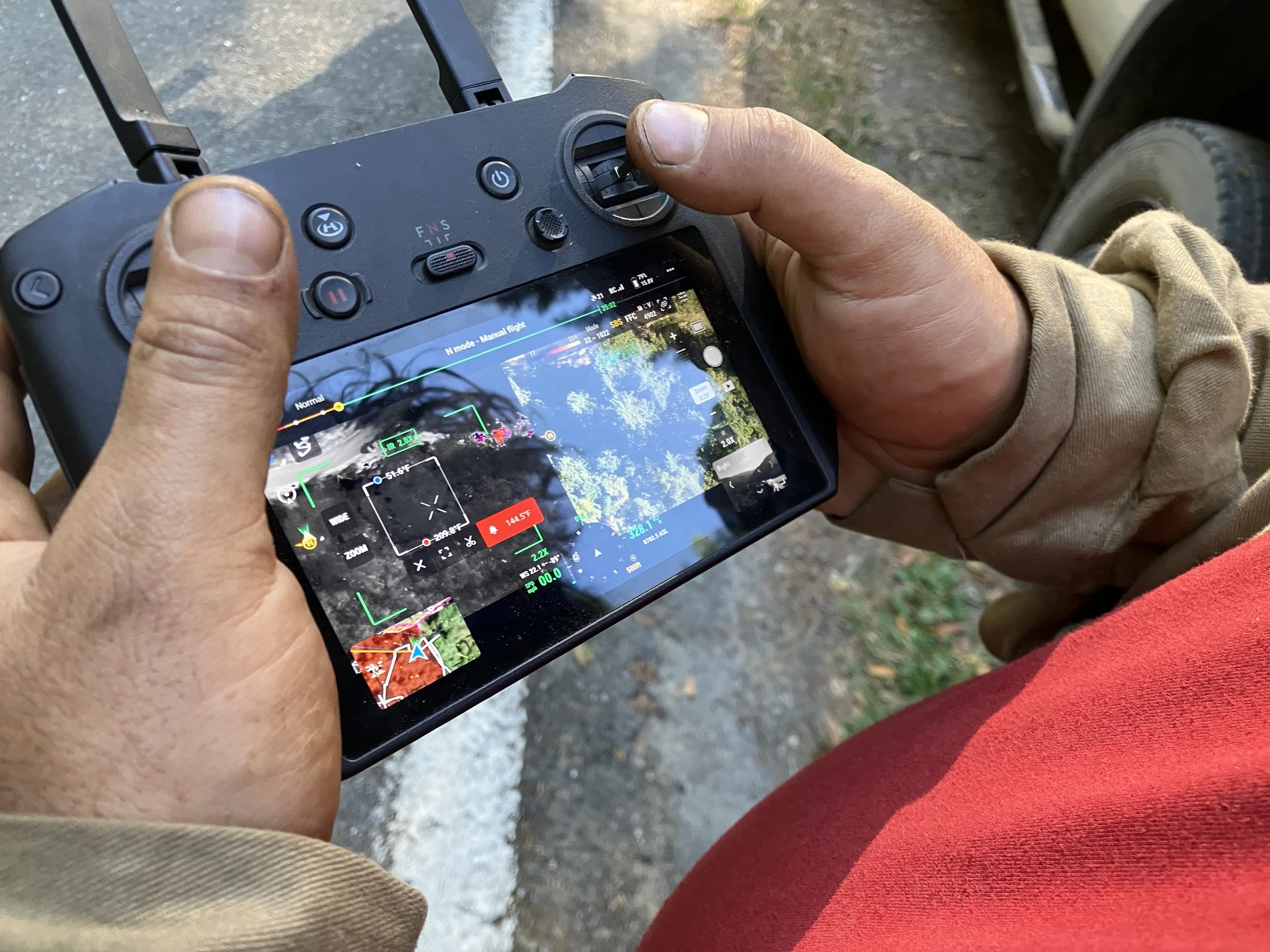
They've been using drones for years to map fire intensity, because you can use heat sensors on the drone to see where the fire is burning and how intensely. But this was the very first time they had used this absolutely enormous drone to drop these little incendiary dragon eggs into the middle of the burn.
Speaker 1 42:34
Flying it is kind of like steering a boat, whereas the other drone is like a hummingbird.
Adam Huggins 42:39
So that was pretty cool.
Isabel Guerra 42:41
Go for firing.
Adam Huggins 42:43
It was big deal.
Max Brotman 42:44
Oh my gosh, there's the freaking dots, guys.
Adam Huggins 42:46
The drone is going to help them access areas that are hard for people to get into, in the middle of those burn blocks, and hopefully make the process more efficient, right? Speed it along a little bit.
Adam Huggins 42:57
When I spoke with many of the crew members, they told me this moment that we're in right now where we're using Nomex clothing and fire engines and all this technology, the drones, the hierarchical structure of a fire crew, the certifications — all of this is this moment that we're passing through because of over a century of fire suppression. The Yurok need to adopt these tools to achieve what they want to achieve in this colonial system, but also because the condition of the forest requires that level of technology, of safety equipment, of planning and of organization. It is so extreme compared to what it was historically. And so the vision that they expressed to me was that this is a transition from a time of fire suppression to a future where community members will just be able to go out into their backyards, into the places where they gather, and light fires themselves, with their family members, and yeah, maybe they call in one of the local engine operators for support. Or maybe that's not even necessary anymore, because the ecosystem is safe to burn, and people have become comfortable enough and knowledgeable enough again that they can just do it when they're ready, when it's time.
Annelia Norris 44:32
Absolutely we have to get it back to where it's safe for people to just light their little Hazel patch or their acorn grove, or whatever it is, you know. What, maybe three years from now, I'll I'll come light this up myself, and then just say hey, I'm gonna light up my Hazel patch So FYI. You guys could be on standby.
Jordan Spannaus 44:55
We do cultural burns and family burns, where we do bring out families and even children sometimes to come and watch or get involved in our burns. All the children and stuff that burn with us get really into it. All talk about wanting to do this when they get older. So I think everything that we're doing out here is pretty good for our community, for all the people around here, I think.
Adam Huggins 45:23
That's a really beautiful vision, not just for fire, but for this time that we're moving through right now, that there is so much to do. We have to work within sometimes, and use the tools that the colonial system has to offer. And then at the same time, we have to be moving towards a place where maybe we don't need them anymore. Like, people have been doing this for 1000s and 1000s of years. When you experience it for yourself, you realize, not only can it be done safely, it's a thing that we can do proactively in a world full of forces beyond our control.
Rick O'Rourke 46:02
She's like, Oh, I wasn't expecting that. You were expecting that monster coming at you, like you see in the news, right? She's like, Yeah. No, it's not like that. There's ways to mitigate all those dangers and then be able to put some fire on the ground.
Adam Huggins 46:16
Doesn't have to be rocket science. Doesn't have to be scary.
Rick O'Rourke 46:21
It doesn't have to be scary. They could be just like peaceful and calming and just a good burn.
Adam Huggins 46:39
End of the second day of burning. It is 2am. We burned until midnight, and I have nothing left. I'm conking out.
Adam Huggins 47:00
By the third day, I had a drip torch in my hand, and I was standing in the middle of a burn block that went as far in each direction as I could see.
Adam Huggins 47:15
Thick patch of poison oak... and Himalayan Blackberry. and it's on fire! But it's burning really good. Standing in the middle of an inferno... wild. What a feeling!
Adam Huggins 47:47
We don't talk about it, but wildfires do not only consume whole landscapes. They they consume living beings. They consume animals. And in a cultural fire, in a prescribed fire, the fire is so much less intense, and it's moving so much more slowly, and it gives many creatures the opportunity to escape and then to return to habitat that is still intact. There are, however, some slow moving creatures that might have gotten out of bed a little bit late that day and need a helping hand.
Adam Huggins 48:19
Hey, Lloyd, I got a little salamander right here that I'm gonna take across the road, alright?
Adam Huggins 48:28
Oh, my God, it's freaking adorable, by the way. All right, little buddy, go free. Stay cool. Oh my God, look at you go! Ah... I love salamanders.
Margo Robbins 48:52
All of the plants and animals, they all have a spirit just like us. And people from this place, our spirit is connected to all of these things. And so when, you know, when they're healthy and feel good, that reflects on us, and it's a link to our health too.
Elizabeth Azzuz 49:17
You know the deer are going to come rolling here tonight. Get rid of their fleas and ticks. They love ash for that. You know, we've seen all these things.
Adam Huggins 49:27
Like what you see, Robert?
Robert McConnell 49:30
This backing fire is beautiful. It's gonna take time, though, because it's so steep in here.
Max Brotman 49:37
Good copy. Yeah, we're getting great backing on this downriver area. Things are looking beautiful.
Amanaka Yancey 49:50
There's beauty you have never seen before that exists in a burn.
Adam Huggins 49:55
So for the people who don't have eyes and are in the future, what are we looking at here?
Will Bruce 50:00
Coming down to the last piece of this burn coming into a nice steep section with fire gently backing through fir trees, Hazel, Bay trees. Kind of like everybody's just in this meditative state, just helping it walk down the hill. You know, you can see, it's just like bringing itself down so nicely.
Adam Huggins 50:37
What do you think be here till midnight putting things out?
Will Bruce 50:45
Yeah, that seems like a fair guess to me.
Adam Huggins 50:49
When a fire has burned its way through a given burn block, it's time to put it out.
Robert McConnell 50:57
We're gonna just touch on our mop up plan, Mech Ney-kem kue po-o.
Adam Huggins 51:02
Because fire suppression has in many ways, been a very militaristic practice. The term that is often used for that is mopping up. But mopping up is a term that was basically used for when soldiers go across the battlefield, look for anybody who's still alive, and kill them. So the CFMC calls the penultimate stage in the burn...
Amanaka Yancey 51:26
Kem kue po-o. We were saying Mech Ney-kem kue po-o, which is put the water on the hot stuff.
Adam Huggins 51:30
Amanaka Yancey, she was my squad lead.
Amanaka Yancey 51:33
Then they shortened it to Kem kue po-o, which is... put water on it.
Adam Huggins 51:38
And it is the unglamorous job of trudging through the ashy landscape with shovels and piss pumps, and putting a little bit of water and a little bit of elbow grease into making sure that every last part of that fire is out. It definitely feels like something you don't want to do at 1am after you've been burning for 10 hours straight, but it is a very important part of the job.
Adam Huggins 52:03
Imagine you end up spending a lot of evenings this way.
Margo Robbins 52:12
Mmm... guess so.
Isabel Guerra 52:12
I love my job.
Adam Huggins 52:16
That night, I didn't record anything before bed, I just hit the ground and was gone.
Adam Huggins 52:27
The day that I left, I woke up so tired and so sore, and all I could think was... where are we going to burn next??
Mendel Skulski 52:42
This episode of Future Ecologies was recorded and reported by my co-host, Adam Huggins. It was edited and produced by me. Mendel Skulski.
Mendel Skulski 52:52
It featured the voices of Elizabeth Azzuz
Elizabeth Azzuz 52:55
Jeez, me and my big mouth. You know, I don't know what possesses me to open the damn thing.
Mendel Skulski 52:58
Dylan Stevens
Dylan Stevens 52:58
When we were prepping, I was like, I think these roots are gonna catch on fire. They did.
Mendel Skulski 53:04
Rick O'Rourke
Rick O'Rourke 53:05
I'm compelled to share my knowledge with people, because it was shared with me from people who forgot more than I'll ever know.
CFMC crew 53:12
Margo Robbins
Margo Robbins 53:13
[Scream]
CFMC crew 53:13
[Screams respond in the distance]
Adam Huggins 53:13
Look what you started. I gotta work on my scream a little bit so that it doesn't sound like I'm in trouble, you know.
Margo Robbins 53:17
It's gotta come from deep in your belly.
Mendel Skulski 53:24
Robert McConnell
Robert McConnell 53:25
Let's have fun. Be safe, learn something.
Mendel Skulski 53:27
Annelia Norris
Annelia Norris 53:29
I can still scale these freaking hillsides, so I'm not that old.
Mendel Skulski 53:32
Isabel Guerra
Mendel Skulski 53:33
You put, you put, you put your time in!
Mendel Skulski 53:35
Amanaka Yancey
Amanaka Yancey 53:36
Prescribed fire so hot right now.
Mendel Skulski 53:38
Jordan Spannaus
Jordan Spannaus 53:39
Gonna take a long time, but this is a good start.
Mendel Skulski 53:42
Claire Brown
Claire Brown 53:43
Like a classic FEMO role is to make a report that nobody reads.
Mendel Skulski 53:47
Max Brotman
Max Brotman 53:48
We don't say breathing smoke, we say eating smoke.
Mendel Skulski 53:52
And Will Bruce
Will Bruce 53:53
I know you wanna burn it all, gotta wait 'til fall!
Mendel Skulski 53:57
and music by C Diab, Thumbug, Adrian Avendaño G̱a̱mksimoon, and Sunfish Moon Light, plus cover art by the wonderful Ale Silva.
Adam Huggins 54:11
Huge gratitude to the CFMC for making this episode possible. I talked to lots of other folks and just couldn't include everything. So thank you to everyone who spoke with me, and special thanks to Margo Robbins, Fern Purdy, Max Brotman, Claire Brown, Will Bruce, and Amanaka Yancey for corresponding with me, helping me put this piece together, hosting me, helping me get my qualifications and keeping me out of trouble on the line. Big thanks to the Confluence Lab at the University of Idaho, and especially Sasha White, who supported me through this process. Thanks also to Anita and Micah Williams.
Mendel Skulski 54:49
You can find the CFMC at culturalfire.org. You can find us and all of our episodes at futureecologies.net, or wherever you listen to podcasts. We make this podcast and keep it ad free with the support of our incredible patrons, who we literally cannot thank enough. To join them, head to patreon.com/futureecologies, and help us make the show for as little as $1 a month. We've got a back catalog of exclusive bonus episodes, 50% discounts on all merch, a Discord server, a book club and more. Plus, you can show off your name at futureecologies.net/join — forever. But the biggest favour you can do us is free. We believe stories can change the world, and really, that's why we make this show, but we need your help for them to spread... and maybe even catch fire.
Mendel Skulski 55:51
'til next time. Stay lit.